Ammonia in refrigeration, agriculture and process air.
Ammonia measurement supports refrigeration leak detection, agricultural emission studies and process monitoring. Each application defines a different exposure pattern. An intermittent leak detector, a continuous livestock-building monitor and an instrument sampling an ammonia-bearing process stream require separate assessments of range, recovery and cell life.
Gas-phase NH₃ concentration is generally reported in ppm by volume. Agricultural measurements may also use emission rates, which require concentration together with a valid airflow measurement and a representative sampling method. A concentration measured at one point cannot establish the total release from a building.
NIOSH identifies ammonia's high water solubility. Moisture, condensation and sample-path surfaces therefore deserve close attention when measuring a gas stream. Record the sampling conditions and investigate losses or delayed recovery in the installed system. Refrigeration safety functions require appropriate detector certification and maintenance procedures.
Biased electrochemical cells and heated semiconductors.
Electrochemical ammonia cells produce a current through electrode reactions. A controlled working-electrode potential may be required: Alphasense specifies a +200 mV bias for NH3-B1. The analog front end must maintain the prescribed electrode relationship while measuring the signal and handling power-up or power-down conditions.
Individual sensitivity can vary considerably. At a hypothetical calibrated gain of 40 nA/ppm, 25 ppm produces a 1,000 nA gas-related current, equivalent to 1 µA. Applying a nominal gain without calibrating the supplied cell introduces a concentration error. Baseline offset is especially important when measuring near the bottom of the range.
Heated metal-oxide sensors use gas-dependent changes in electrical resistance. Figaro's TGS826 uses tin oxide: ammonia increases conductivity, reducing sensing resistance. A load resistor converts this change into a measurable voltage. The concentration relationship is nonlinear and is influenced by humidity, temperature and other gases.
The heater establishes the sensing temperature and contributes substantially to power consumption. Figaro's public TGS826 sheet lists about 833 mW heater power and a seven-day preconditioning period for its standard test. An installation needs the prescribed conditioning and a validated startup sequence before reporting settled measurements.
Ammonia sensor terminology.
- Operating bias
- Specified electrode potential required by a biased electrochemical cell.
- Span sensitivity
- Signal change per concentration unit following calibration with a defined gas.
- Zero offset
- Signal remaining in zero gas, sometimes expressed as an equivalent ammonia concentration.
- Adsorption
- Retention at a surface, which can delay transport and recovery in a sample path.
- Absorption
- Uptake into a material or liquid, including ammonia uptake into water.
- Rs/Ro
- Normalized semiconductor resistance relative to a specified reference condition.
- Exposure duty
- Concentration and duration of exposure, including recovery intervals.
- Emission rate
- Released mass per unit time, requiring additional flow and sampling information.
Semiconductor development and ammonia-specific designs.
Figaro's company history places commercial development of Taguchi tin-oxide gas sensors in 1968 and company establishment in 1969. Subsequent material and device development enabled sensor families with differing gas responses. Current catalogs include ammonia-responsive semiconductor models alongside electrochemical products.
The publicly linked TGS826 sheet carries REV 05/04. Its test conditions remain useful engineering evidence, while procurement should confirm the current supplied model and documentation. Membrapor's December 2025 NH3/CR-1000 revision specifies leak detection and discontinuous measurement. These dates identify the documents used here; they do not establish product launch dates.
Ammonia manufacturer and model options.
Alphasense NH3-B1 provides a biased electrochemical approach. Membrapor NH3/CR-1000 extends the nominal range for intermittent exposure. Figaro TGS826 provides a heated semiconductor approach with a resistance output. Selection depends on exposure duty, interfering gases, required uncertainty and available power.
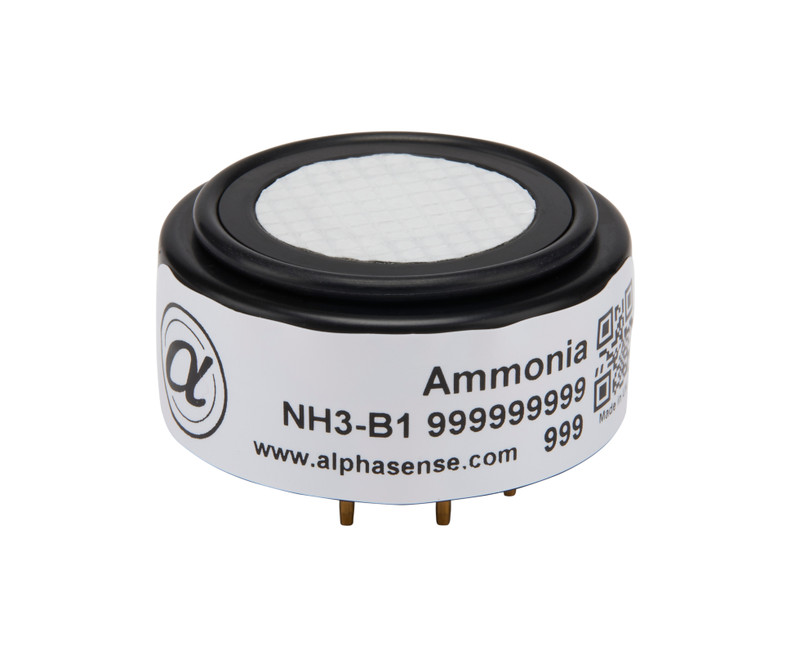
NH3-B1
- Technology
- Three-electrode electrochemical cell
- Measurement
- 100 ppm range; 20–60 nA/ppm at 50 ppm NH₃; T90 <150 s
- Interface
- Biased electrode current; +200 mV operating bias
- Consider for
- Embedded ammonia detection systems
- Integration consideration
- Bias control, conditioning and interference correction require model-specific circuitry.
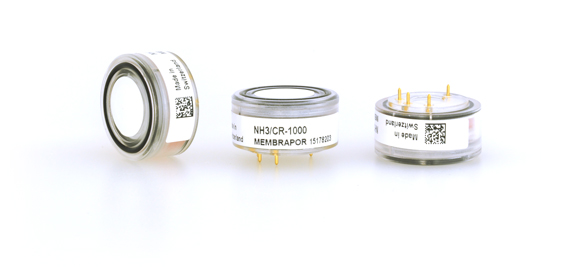
NH3/CR-1000
- Technology
- Three-electrode electrochemical cell
- Measurement
- 0–1,000 ppm nominal; 25 ±8 nA/ppm; T90 <35 s
- Interface
- Electrode current; calibrated analog front end
- Consider for
- Leak detection and discontinuous sampling
- Integration consideration
- Manufacturer specifies discontinuous measurement. Continuous exposure needs a separate suitability assessment.
TGS826
- Technology
- Heated metal-oxide semiconductor
- Measurement
- Typical detection range 30–300 ppm NH₃
- Interface
- Resistance readout; 5 V heater
- Consider for
- Ammonia-responsive equipment designs
- Integration consideration
- Heater consumes about 833 mW. Other gases and humidity affect response; public product sheet is REV 05/04.
Membrapor specifies a pure-air baseline equivalent of −16 to +16 ppm for NH3/CR-1000. That baseline matters in low-concentration work even though the nominal range reaches 1,000 ppm. Alphasense gives NH3-B1 sensitivity at 50 ppm and T90 for the zero-to-50 ppm step. Response comparisons need their original test conditions.
Sample integrity, exposure duty and calibration.
Use a short, suitable sample path and prevent uncontrolled condensation. Validate delivery with the actual tubing, filters and flow. Ammonia can show delayed arrival or persistent recovery tails after a concentration change; the entire sampling system should be characterized before interpreting transient events.
Confirm whether the selected cell tolerates continuous exposure at the expected concentration. Membrapor's discontinuous specification deserves explicit consideration for agricultural monitoring. A model intended for periodic leak measurements may need a different exposure arrangement from a continuously exposed barn sensor.
Perform zero and span calibration under documented conditions. Include humidity and temperature measurements so environmental effects can be investigated. Evaluate relevant interfering gases: electrochemical response can be positive or negative, and semiconductor response depends on gas mixture and operating conditions.
For bare electrochemical cells, provide electrode control and low-current measurement. Semiconductor systems require stable heater power, resistance readout and a validated calibration function. Complete transmitters should document their own analog or digital interface, alarm behavior and fault states. Installed costs include sample conditioning, power, calibration gases, servicing and replacement sensing elements. Avoid quoting component price as the cost of a functioning monitoring system.
Ammonia sensing questions.
Why can a long sampling tube slow an ammonia measurement?
Transport time and interaction with surfaces or moisture can delay delivery and recovery. Measure the response of the complete sample path under representative conditions.
Can NH3/CR-1000 measure a barn continuously?
The published specification identifies discontinuous measurement. Continuous agricultural use requires a suitable model or an exposure arrangement confirmed by the manufacturer.
Does a 1,000 ppm range guarantee accurate readings near zero?
Low-range performance also depends on baseline, noise, calibration and interference. NH3/CR-1000's stated baseline equivalent is relevant to this assessment.
What does NH3-B1's bias requirement change?
The readout must maintain the specified +200 mV electrode bias and follow the manufacturer's conditioning and power-state recommendations.
Read the original documentation.
Specifications use the linked manufacturer documents and their stated revisions. Review the current datasheet and exact ordered variant before final specification. Comparisons use manufacturer specifications and technical documentation.