VOC sources and measurement objectives.
Volatile organic compounds can enter air from solvents, cleaning agents, coatings, furnishings and other sources. “VOC” describes a broad chemical family, so a single sensor response does not identify every compound or its concentration. Begin by deciding whether you need relative indoor trends, a response to a known compound or a survey instrument with a defined calibration.
A total-VOC result is meaningful only with its measurement method, calibration basis and units. An index is a separate kind of output. It can help detect changes against a baseline, but it is not interchangeable with ppm, ppb or a compound-specific laboratory result.
Metal-oxide and photoionization sensing.
A metal-oxide gas sensor uses a heated sensing surface. Interactions between gases and that surface change its electrical resistance. Temperature control, humidity compensation and software convert the response into a useful signal. The sensing layer can respond to several gases, which makes it useful for trends but limits chemical selectivity.
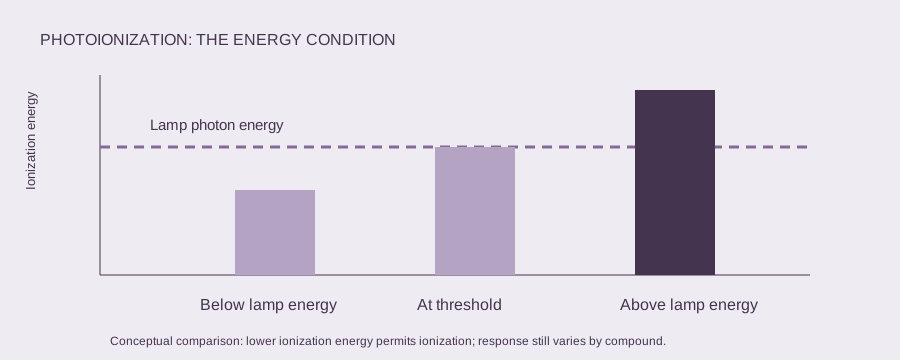
A photoionization detector, or PID, illuminates the sample with ultraviolet light. Compounds with suitable ionization energies can form ions; the measured current is related to their abundance. Lamp energy determines which compounds can be ionized. A PID does not respond equally to every VOC, and compounds above the lamp's ionization energy may not be detected.
PID readings are usually referenced to a calibration gas such as isobutylene. For a known compound, manufacturer response factors may support a conversion under specified conditions. In an unknown mixture, the combined response does not reveal the concentration of each constituent. Lamp condition, contamination and sampling design remain part of the measurement.
VOC indices, units and response factors.
- VOC Index
- A processed, relative signal from a specific algorithm. Interpretation depends on that algorithm and its baseline history.
- ppm and ppb
- Parts per million and parts per billion. 1 ppm equals 1,000 ppb when both represent the same fraction.
- Response factor
- A manufacturer-defined relationship between a compound's detector response and the calibration-gas response. Follow the specified multiplication or division convention.
- Ionization energy
- The energy needed to remove an electron. The relationship to PID lamp energy influences whether a gas can be detected.
- Cross-sensitivity
- Response to substances other than the intended target. An output change alone does not prove the target gas is present.
- Equivalent CO₂
- An inferred software output based on other sensor responses. It does not replace a direct CO₂ measurement.
Different paths to compact gas detection.
Heated semiconductor gas sensing provided compact electrical responses to changing gas mixtures. MEMS hotplates and integrated electronics later reduced package size and enabled controlled heating patterns. Modern metal-oxide components pair the sensing element with compensation and algorithms, so software is part of their behavior.
Photoionization developed along a different path: using photon energy and ion collection to detect responsive compounds. OEM PID components bring that method into instrument designs, while complete portable and fixed instruments add sampling, calibration controls and application-specific approvals. Selection also depends on the sampling system, calibration procedure and instrument approvals.
VOC sensor manufacturers and output types.
Sensirion SGP40 supports indoor VOC trend applications. Bosch BME688 combines gas sensing with environmental measurements and a software ecosystem. ION Science MiniPID 2 PPM offers a PID response for instrument integration. Their outputs do not represent the same measurement.
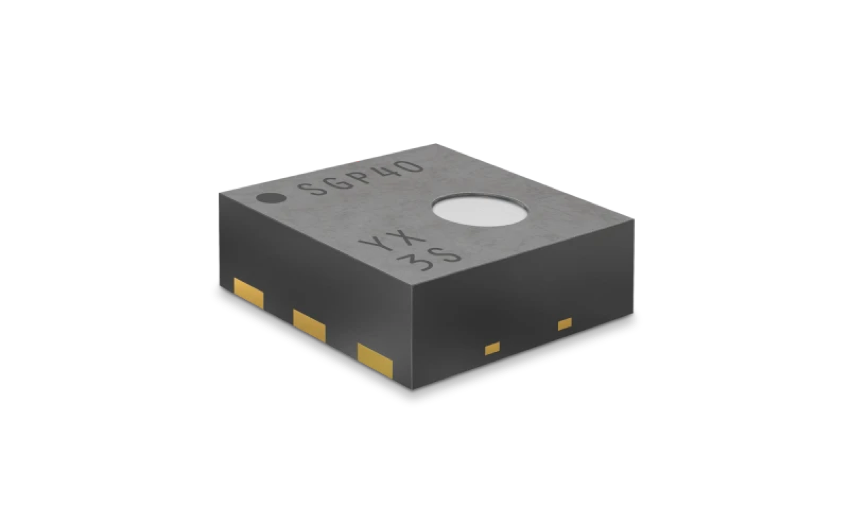
SGP40
- Technology
- Metal-oxide VOC component
- Measurement
- VOC Index through manufacturer algorithm
- Interface
- I²C
- Consider for
- Relative indoor VOC trend tracking
- Integration consideration
- Index is not a chemical-specific concentration. Requires host algorithm and humidity compensation.

BME688
- Technology
- Gas-resistance and environmental component
- Measurement
- Gas resistance; software-dependent IAQ outputs
- Interface
- I²C / SPI
- Consider for
- Embedded gas-pattern development
- Integration consideration
- Model training and software matter. CO₂-equivalent output is not measured CO₂.
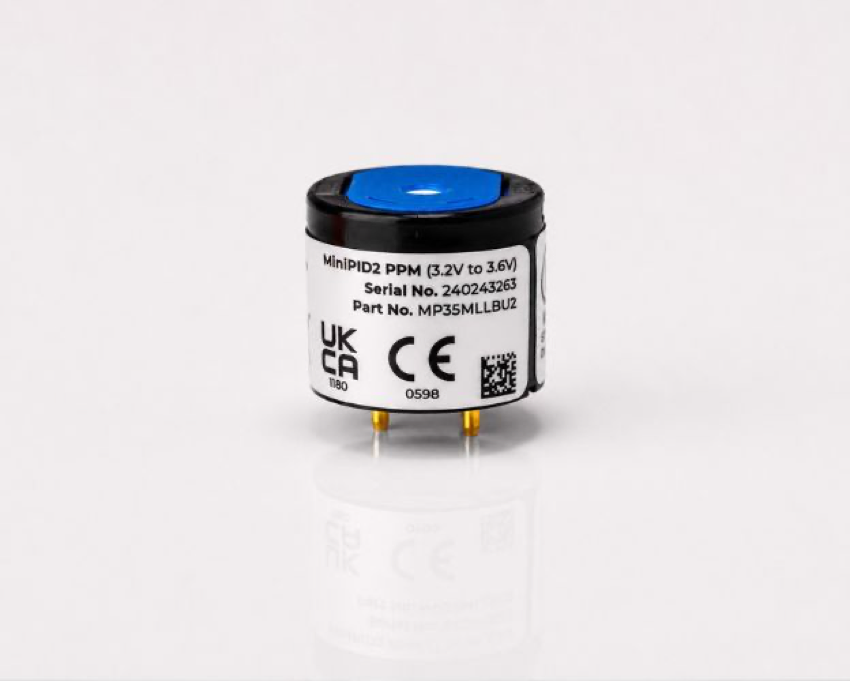
MiniPID 2 PPM
- Technology
- Photoionization detector component
- Measurement
- 10.6 eV lamp; isobutylene-referenced response
- Interface
- Analog signal; integration electronics required
- Consider for
- VOC surveys and instrument design
- Integration consideration
- Response factors vary by compound. Lamp and electrode maintenance required.
For BME688 gas classification, performance depends on the trained model, gas mixture and deployment conditions. A classifier result is not evidence of universal gas identification. For MiniPID, verify the exact variant and calibration-gas response.
Conditioning, calibration and data records.
Follow the conditioning and startup procedure for the sensing element and algorithm. Supply temperature and humidity compensation inputs where required. Keep silicones, adhesives and other materials that can contaminate or alter a sensor away from the sampling path. An enclosure's own emissions can become part of the signal.
For PID systems, use the specified calibration gas and maintenance procedure. Inspect the lamp and electrode stack at the required interval. Verify the response to the compounds of interest and whether any gases are invisible to the selected lamp. A detection limit measured for one calibration gas is not a universal limit for all mixtures.
In a data platform, retain the raw gas signal where available, the processed index, algorithm version, operating time and environmental measurements. Avoid labeling an index as ppm. Record event context before attributing a peak to a particular chemical. Select approved complete instruments when measurements govern occupational safety.
VOC sensor questions.
Can one sensor tell me which VOC is present?
Usually not. A broad response or index does not chemically identify a mixture. Use an appropriate selective method or validated application-specific system when identification matters.
Can I compare the numbers from different VOC indices?
Only after understanding each algorithm. Different scales, baselines and conditioning can produce different numbers for the same air sample.
Does a zero PID reading mean clean air?
No. A PID may not detect compounds outside its lamp response, and it does not measure particles or every gas. Match instruments to the expected substances.
Read the original documentation.
Specifications use the linked manufacturer documents and their stated revisions. Review the current datasheet and exact ordered variant before final specification. Comparisons use manufacturer specifications and technical documentation.