Gas-phase chlorine in air.
Chlorine gas monitoring supports water-treatment installations, chemical handling and industrial leak investigations. The measurement is molecular Cl₂ in a gas sample, commonly expressed in ppm by volume. Dissolved free chlorine and chlorine dioxide require different measurement methods and calibration.
Specify expected concentration, required uncertainty, sampling interval and exposure pattern. A nominal 20 ppm span gives little information about baseline stability at a much lower concentration. Interfering oxidizing or reducing gases can be important in the same installation.
Personnel protection and alarm functions require suitable complete detectors and documented maintenance. Sample delivery should be assessed before interpreting a low reading near a potential release source.
Electrochemical reduction and signed current.
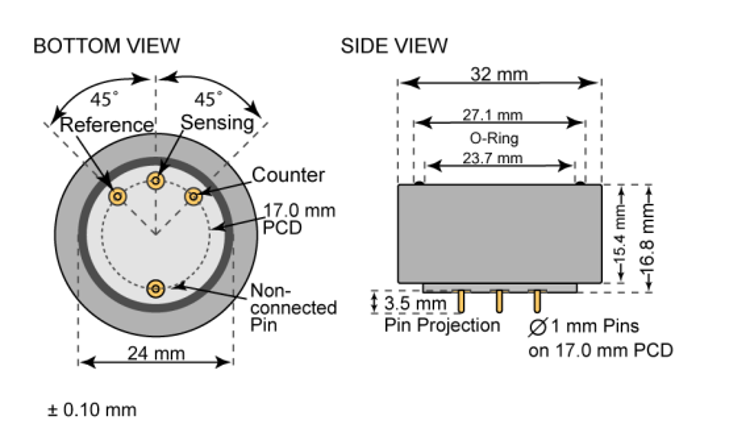
Chlorine reacts at the working electrode after crossing a diffusion barrier. The counter and reference electrodes support the reaction and control electrode conditions. The readout measures current and applies zero and span calibration.
The compared models specify a negative current sensitivity. Membrapor Cl2/C-20 lists −900 ±250 nA/ppm. Using a hypothetical calibrated gain of −900 nA/ppm, 0.5 ppm produces −450 nA of gas-related current. Electronics and software need to preserve that sign through baseline subtraction and concentration conversion.
Alphasense CL2-B1 specifies substantial response to some other gases, including H₂S and NO₂. Interference can have a different sign from target-gas response. Clipping intermediate negative values or applying a generic correction can conceal useful diagnostic information.
Cell-level response time is measured with a specified concentration step and circuit. A pumped installation additionally includes tubing, inlet and flow delays. The complete response should be measured under representative conditions.
Chlorine measurement terminology.
- Cl₂
- Molecular chlorine in the gas-phase measurement discussed here.
- Signed sensitivity
- Current change per ppm with the electrode-current polarity retained.
- Zero current
- Signal under a defined chlorine-free reference condition.
- Cross-response
- Signal caused by another gas under a specified test exposure.
- T80 and T90
- Response times to 80% and 90% of the final signal, respectively.
- Sample loss
- Reduction in delivered chlorine concentration through reaction or retention along a sample path.
Chlorine cells and document revisions.
The Alphasense source combines CL2-B1/CL2-B1+ Version 1.1 specifications with performance figures carrying a March 2017 reference. Membrapor's cited Cl2/C-20 sheet carries a December 2025 revision.
Those documents demonstrate the importance of version-specific interpretation. The standard CL2-B1 and smart-board version have different electronics; the performance figures retain the conditions and dates printed in the source.
Chlorine manufacturer options.
Alphasense and Membrapor supply three-electrode cells with signed current outputs. Both need integration electronics and calibration. Their response-time definitions and interference tables should retain the original test conditions.
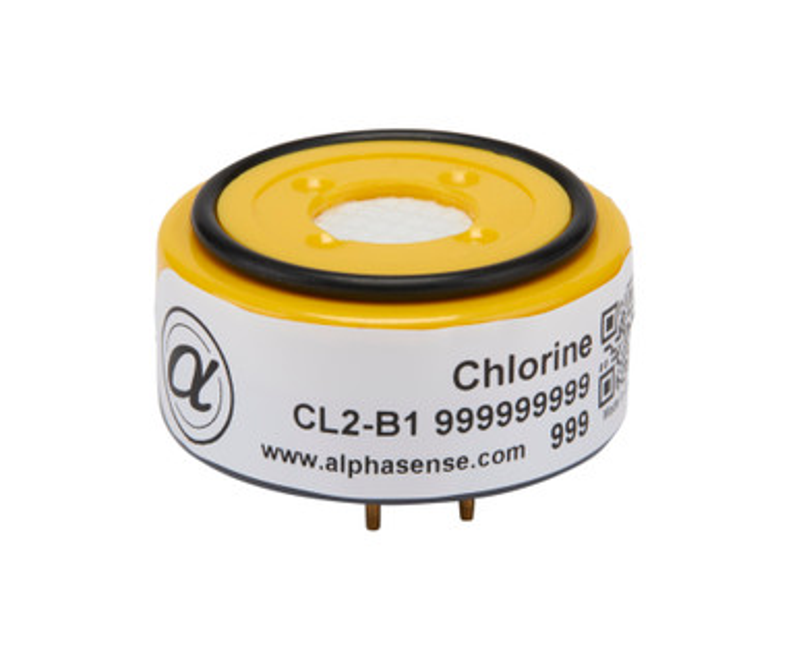
CL2-B1
- Technology
- Three-electrode electrochemical chlorine cell
- Measurement
- 20 ppm performance-warranty range; −600 to −1,150 nA/ppm at 10 ppm
- Interface
- Signed electrode current; analog front end
- Consider for
- Embedded chlorine monitoring instruments
- Integration consideration
- H₂S and NO₂ interference can be substantial. CL2-B1+ adds a separate smart board; standard cell requires its own electronics.
Cl2/C-20
- Technology
- Three-electrode electrochemical chlorine cell
- Measurement
- 0–20 ppm; sensitivity −900 ±250 nA/ppm; T80 <60 s
- Interface
- Electrode current; model-specific analog front end
- Consider for
- Custom chlorine gas instruments
- Integration consideration
- No inboard filter. Cross-sensitivity, baseline and sample delivery require application validation.
Membrapor specifies T80, while Alphasense specifies T90. A direct comparison of those numerical times would combine different endpoints. Neither model's range guarantees a finished instrument's low-concentration uncertainty.
Reactive sampling and interference assessment.
Use materials and a sample arrangement compatible with chlorine. Minimize unnecessary tubing and establish how filters, moisture and surfaces affect delivery and recovery. Verify the assembled path with a controlled concentration step and the intended flow.
Assess likely interfering gases at the site. Chlorine dioxide, ozone and nitrogen dioxide have their own sensing behavior; identify the actual chemical used in the process. Preserve negative as well as positive cross-response during instrument development.
Perform zero and span checks with the documented circuit and target gas. Record environmental conditions, baseline, calibrated sensitivity and exposure history. Replace or service cells according to the complete instrument's maintenance schedule.
Provide electrode control, low-current readout and temperature treatment as required. A complete transmitter may expose an industrial interface, while the bare cells compared here produce electrode current. Cost comparisons need enclosure, alarm equipment, calibration gas, sample handling, interface electronics and service access.
Chlorine sensing questions.
Can a Cl₂ gas cell measure dissolved chlorine in water?
It measures chlorine delivered to its gas-facing electrode. A dissolved measurement needs a suitable water method or a validated sampling conversion.
Why does the datasheet show negative sensitivity?
The specified electrode reaction gives the documented signal direction. The measurement circuit and calibration must retain that polarity.
Are T80 and T90 interchangeable?
They use different response endpoints. Compare sensors with the original step conditions and response definition.
Read the original documentation.
Specifications use the linked manufacturer documents and their stated revisions. Review the current datasheet and exact ordered variant before final specification. Comparisons use manufacturer specifications and technical documentation.