Low-level formaldehyde in indoor air.
Formaldehyde monitoring is used to investigate building materials, furnishings, manufacturing processes and changes in indoor ventilation. The quantity is gas-phase HCHO concentration, usually expressed in ppb or ppm by volume. Temperature, humidity, ventilation and the age of an emitting material can influence the concentration observed in a room.
The measurement objective determines the required range and uncertainty. A low-level indoor study needs adequate baseline stability around the concentrations of interest. A process survey can need a larger span and recovery after higher exposure. Source location, averaging interval and measurement uncertainty belong beside the concentration record.
Alcohols and cleaning products can affect some formaldehyde sensors. Model-specific cross-sensitivity evidence is therefore useful when evaluating a sensor for occupied spaces. A broad VOC channel provides different information from a selective HCHO measurement.
Selective electrochemical measurement.
Formaldehyde reacts at the working electrode of an electrochemical cell. Gas transport and electrode chemistry relate current to concentration. The readout applies baseline correction and calibrated sensitivity; biased cells additionally require controlled electrode potential.
Sensirion SFA30 combines the cell with electronics, calibration and temperature/humidity compensation. Membrapor CH2O/CA-10 provides a three-electrode component requiring an external measurement system and +200 mV bias. These formats have different commissioning requirements.
For a hypothetical calibrated cell sensitivity of 1,500 nA/ppm, 0.10 ppm produces 150 nA of gas-related signal. The concentration also equals 100 ppb. Baseline current and electrical leakage can be material at this level; applying a nominal sensitivity without individual calibration introduces additional error.
SFA30's standard range is 0–1,000 ppb, while its numerical output saturates at 5,000 ppb. Its accuracy specification applies to a smaller range and specified environmental conditions. Those three limits serve different purposes in an instrument specification.
Formaldehyde measurement terminology.
- ppb
- Parts per billion by volume; 1 ppm equals 1,000 ppb.
- Cross-sensitivity
- Response to another substance, such as ethanol, under documented exposure conditions.
- Operating bias
- Controlled potential between the specified electrodes.
- Baseline stabilization
- Settling of the zero-gas output after conditioning or bias application.
- Output saturation
- The concentration-equivalent limit of the reported numerical signal.
- Reference analysis
- An established measurement method used to assess sensor response and bias.
Selective cells and integrated compensation.
Membrapor announced CH2O/CA-10 on 19 April 2022, identifying reduced alcohol interference as a development objective. Its December 2025 sheet specifies operating bias and stabilization conditions. Sensirion's January 2025 SFA30 revision documents an integrated low-level module with temperature and humidity treatment.
These documents show two adoption routes: developing a cell-based instrument or integrating a calibrated module. Selectivity should be assessed with the substances present in the intended environment and an independent reference where the measurement informs consequential decisions.
Formaldehyde manufacturer options.
Sensirion and Membrapor provide different ranges and integration levels. SFA30 reduces the external analog design burden. CH2O/CA-10 gives access to a raw-cell signal for a custom instrument, with individual calibration and bias control.
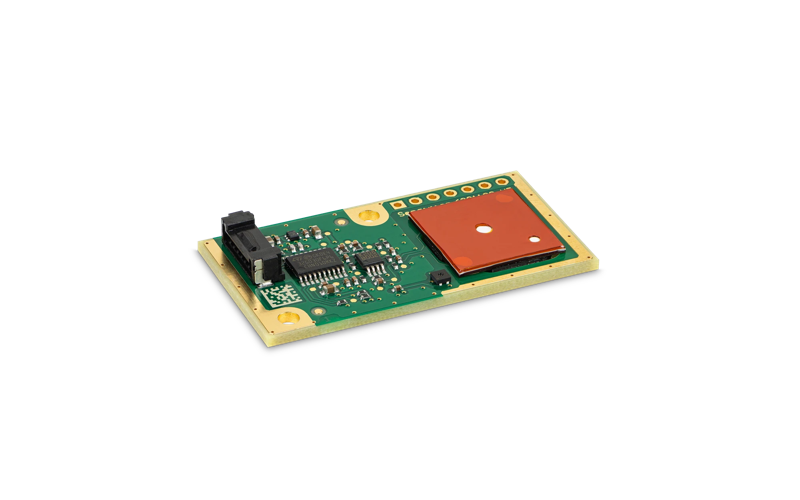
SFA30
- Technology
- Calibrated electrochemical formaldehyde module
- Measurement
- Standard 0–1,000 ppb; output saturation 5,000 ppb
- Interface
- I²C / UART; 3.15–5.5 V supply
- Consider for
- Low-level indoor formaldehyde monitoring
- Integration consideration
- Accuracy ±20 ppb or ±20% of reading, whichever is larger, at specified clean-air conditions within 0–200 ppb.
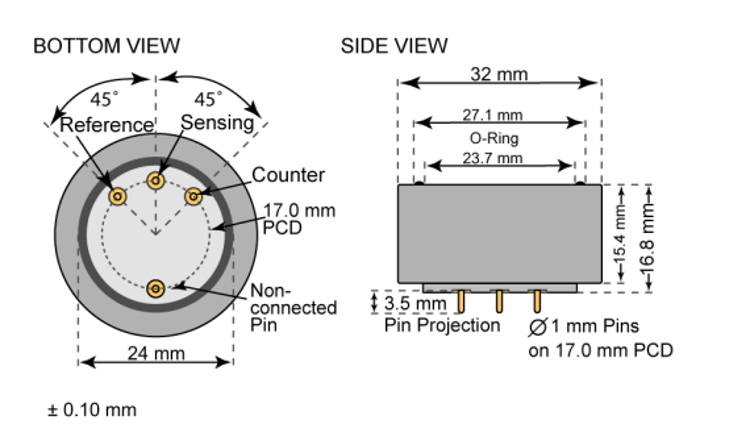
CH2O/CA-10
- Technology
- Three-electrode electrochemical formaldehyde cell
- Measurement
- 0–10 ppm; 1,500 ±500 nA/ppm; T60 <90 s
- Interface
- Electrode current; +200 mV bias
- Consider for
- Custom formaldehyde instruments
- Integration consideration
- Fresh biased sensors need 24–72 h baseline stabilization; low-level performance depends on baseline and electronics.
CH2O/CA-10 lists a pure-air baseline equivalent from 0 to 1 ppm, and fresh biased cells need 24–72 hours to stabilize. Its range alone cannot establish low-ppb instrument performance. SFA30's stated ethanol response is tied to a 5 ppm ethanol test.
Placement, validation and service requirements.
Position a room monitor to represent the intended occupied zone and avoid direct breath, a concentrated source plume or an isolated enclosure pocket unless those are the study targets. Maintain gas access and separate the sensor from electronics heat. Record temperature and humidity during evaluation.
Assess common cleaning products and alcohol exposure under controlled conditions. Compare with a suitable formaldehyde reference over representative concentration and environmental ranges. Include zero checks and recovery after elevated exposure; a transient event can outlast the release when the sample path or sensing system retains the compound.
Follow model-specific conditioning, storage and calibration instructions. A biased bare cell needs a suitable potentiostat, current conversion and low-leakage assembly. Digital modules still require supply, protocol handling, enclosure design and fault reporting. Compare installed cost including reference checks, calibration equipment, interface electronics, replacement sensors and service access.
Formaldehyde sensing questions.
Can a VOC Index be converted into formaldehyde ppb?
A broad gas index has a different response definition. Formaldehyde concentration requires a documented HCHO measurement and calibration.
Why does CH2O/CA-10 require several days of initial conditioning?
The manufacturer specifies 24–72 hours for fresh biased sensors to stabilize their baseline. Commissioning should include that period and subsequent zero/span assessment.
Does SFA30's 5,000 ppb output limit define its accuracy range?
The standard range and accuracy conditions are specified separately. Use the datasheet's concentration and environmental conditions when assessing uncertainty.
Read the original documentation.
Specifications use the linked manufacturer documents and their stated revisions. Review the current datasheet and exact ordered variant before final specification. Comparisons use manufacturer specifications and technical documentation.