Spatial coverage and comparable outdoor measurements.
An outdoor sensor network samples conditions at several locations to investigate spatial and temporal patterns. Its usefulness depends on pollutant choice, site representativeness, measurement uncertainty and consistent data handling. More locations provide additional samples, while each still requires validation.
Specify whether the study concerns neighborhood variation, a source boundary, a roadside gradient or a background site. Location, height, nearby surfaces, obstructions and airflow shape the sample. Meteorological records help interpret dispersion and environmental response.
Gas concentrations, PM mass estimates and particle counts have different definitions. Retain the measurement method and units at each node. Regulatory or reference-method claims require the relevant instrument status and evidence.
Collocation, environmental response and network uncertainty.
Each node combines sensing, sample handling, power, acquisition and communication. Enclosures and weather protection can alter gas exchange, temperature or particle transport. The network's final output reflects the assembled node rather than the sensing component alone.
Collocation places sensors with a suitable reference to assess bias, precision and environmental behavior. Match timestamps and averaging periods before evaluating differences. Include representative concentrations, seasons and interfering gases.
Calibration models can depend on local conditions. A model fitted at one site or season should be validated before transfer. Retain raw values and model versions so revised processing remains auditable.
Data completeness affects summaries. If a node supplies 80 valid hourly records out of 100 expected hours, completeness is 80%. Compare pollutant averages only with an explicit valid-data rule, and investigate whether missing periods are associated with weather or high concentrations.
Outdoor network terminology.
- Collocation
- Concurrent measurement with a suitable reference at a defined site.
- Representativeness
- The relationship between a sampled location and the intended study area or population.
- Completeness
- The fraction of expected records meeting the defined validity rule.
- Drift
- Change in baseline or sensitivity over time.
- Transferability
- Suitability of a calibration or correction model under different conditions.
- Provenance
- The retained history of sensor, calibration, location and processing.
- Quality flag
- A state identifying suspect, invalid or interrupted measurement.
Sensor networks and evaluation guidance.
EPA's 2014 Air Sensor Guidebook and 2022 enhanced edition document the growth of lower-cost sensing and the associated need for evaluation and interpretation. Its siting guidance addresses gas access, obstructions and collocation considerations.
Networks now combine compact optical and electrochemical sensors with more established analyzer formats. That combination is useful when each instrument's role, uncertainty and environmental suitability are explicitly defined.
Outdoor measurement and manufacturer options.
Alphasense OPC-N3 supplies particle-size and concentration-related measurements. NO2-B43F supplies a filtered electrochemical NO₂ cell. 2B Technologies Model 106-L supplies sampled UV ozone analysis. They represent different node-development burdens and measurement levels.
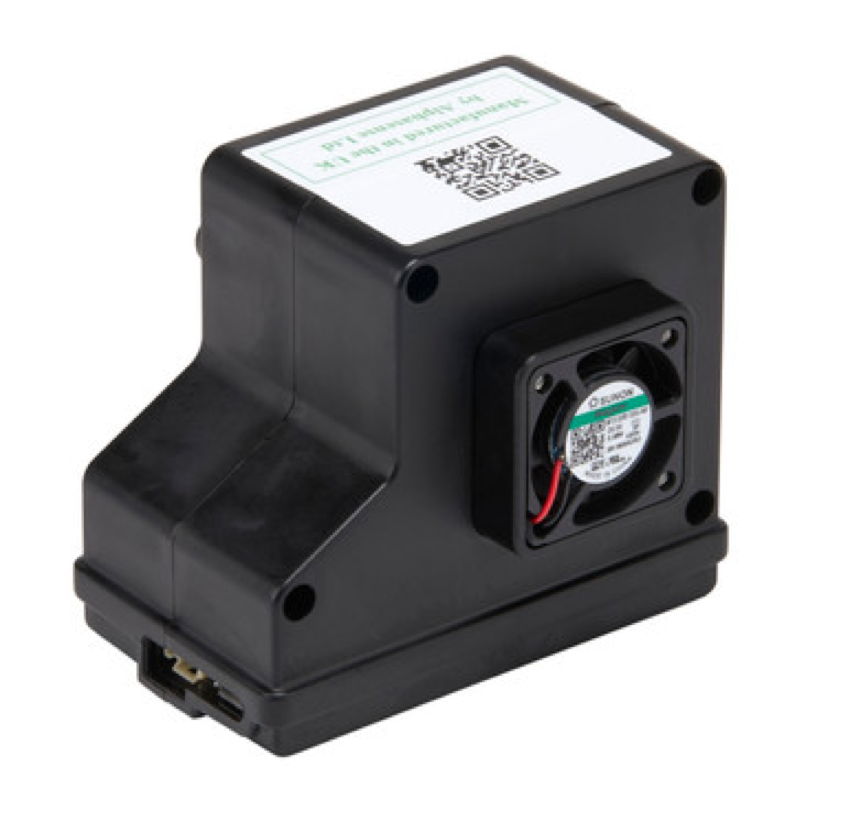
OPC-N3
- Technology
- Optical particle counter
- Measurement
- PM1, PM2.5, PM10 and PM4.25 outputs
- Interface
- SPI; see manufacturer cable and datasheet
- Consider for
- Particle-size distribution projects
- Integration consideration
- Needs host electronics and a protected sampling design.
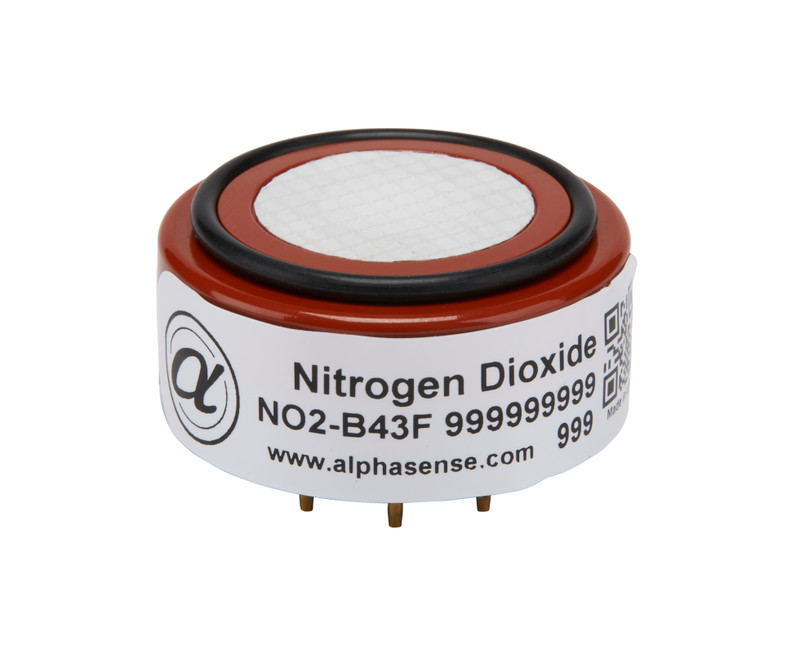
NO2-B43F
- Technology
- Four-electrode electrochemical NO₂ cell
- Measurement
- 20 ppm stated range limit; −200 to −650 nA/ppm at 2 ppm NO₂
- Interface
- Signed electrode current; analog front end required
- Consider for
- Environmental NO₂ instrument development
- Integration consideration
- Ozone filter and auxiliary electrode require model-specific treatment. Noise is specified with Alphasense ISB circuitry.
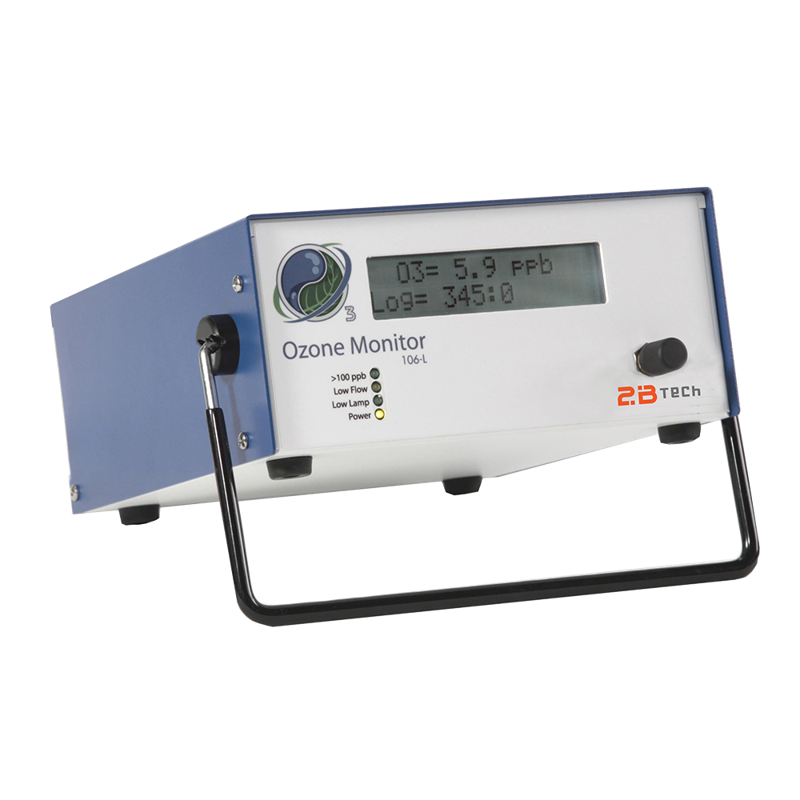
Model 106-L
- Technology
- Single-beam UV absorption at 254 nm
- Measurement
- Current range 0–20 ppm; accuracy: greater of 1.5 ppb or 2% of reading
- Interface
- USB, RS232, scalable 0–2.5 V and 4–20 mA outputs
- Consider for
- Complete sampled ozone analyzer installations
- Integration consideration
- 3 ppb detection limit at 10-second averaging, 2σ criterion. Requires powered sampling and calibration. Older official documentation lists a different range.
Bare cells and optical components need suitable enclosures and electronics. The 106-L analyzer's sample and operating requirements also remain applicable; inclusion in this comparison does not establish weatherproof deployment. Confirm the current ordered range and interface configuration.
Siting, service access and data continuity.
Document coordinates, height, surrounding sources, obstructions and photographs of each site. Maintain consistent placement during comparisons. Use weather protection that meets device requirements and preserves a characterized sample path.
Log temperature and humidity, and obtain relevant wind or weather context for dispersion studies. Investigate condensation, water uptake by particles and temperature-sensitive gas baselines. Revisit collocation after replacement or major environmental changes.
Plan power and communications for interruptions. Timestamp records at measurement and preserve buffered data, faults and recovery events. Clock alignment and duplicate handling are important when combining several nodes into one time series.
Compare lifetime cost including enclosure, installation, reference checks, service visits, connectivity, calibration gases and replacements. Maintain a node inventory with configuration and firmware versions. Publish summaries with averaging, completeness and uncertainty rules so spatial patterns can be assessed against their measurement limits.
Outdoor sensor-network questions.
Can an indoor component become an outdoor node through a cover alone?
The completed enclosure needs environmental and sample-path validation. A cover can change airflow, temperature and response.
Can one collocation correction be used everywhere?
Validate transfer across sites, seasons and gas mixtures. A fitted correction can depend on the conditions used to develop it.
How should interrupted records affect an average?
Apply a documented valid-data and completeness rule. Investigate systematic gaps and retain missing periods explicitly.
Read the original documentation.
Specifications use the linked manufacturer documents and their stated revisions. Review the current datasheet and exact ordered variant before final specification. Comparisons use manufacturer specifications and technical documentation.