Nitrogen dioxide concentration.
Nitrogen dioxide, NO₂, is a reactive gas associated with combustion emissions and atmospheric chemistry. Monitoring applications include roadside air quality, combustion-related indoor sources, tunnels and industrial installations. Sampling position and time resolution depend on whether the objective is an ambient trend, a source investigation or an approved exposure-monitoring application.
Ambient NO₂ is commonly reported in parts per billion by volume, ppb. One ppm equals 1,000 ppb, so 0.05 ppm is 50 ppb. Concentration, averaging interval and measurement uncertainty should be stored together. A sensor that reports decimal places can still have substantial baseline uncertainty at low concentrations.
In air-quality and combustion reporting, NOₓ generally groups nitric oxide, NO, and nitrogen dioxide. NO can react with ozone to form NO₂. A single NO₂ sensor provides the measurement for its specified gas channel; an NOₓ measurement requires the appropriate additional channel or analyzer method. Carbon monoxide can be a useful additional combustion measurement when the application calls for it.
Electrochemical sensing and ozone interference.
An electrochemical NO₂ cell admits gas to a catalytic working electrode through a controlled diffusion path. Electrode reactions and ionic transport through the electrolyte produce an electrical current. A reference electrode supports control of the working-electrode potential; some designs add an auxiliary electrode for baseline correction. The electronics convert the calibrated current response into concentration.
NO₂ sensing commonly produces a current response with a negative sign under the manufacturer’s convention. Both the Alphasense and Membrapor specifications compared below retain this sign. Signal-conditioning circuits and conversion software must accommodate the specified polarity, baseline and operating potential.
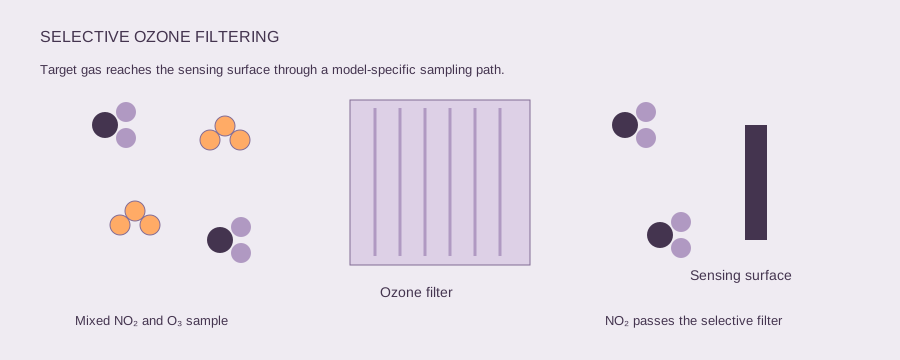
Ozone can also produce a response in an electrochemical NO₂ channel. Manufacturers use selective ozone filters, compensation methods or paired measurements to reduce this interference. A filter must pass the target gas while controlling the unwanted response. Its exposure history, capacity and effect on response time are part of instrument performance.
A complete analyzer can add controlled sampling and repeated zero measurements. Aeroqual’s fixed NO₂ analyzer module, for example, uses sample/zero cycling. The portable END sensor head compared in this guide has its own specifications and host requirements. Analyzer-module performance figures should be applied to the module and measurement procedure for which they were established.
NO₂ measurement parameters.
- ppb and ppm
- Gas-volume fractions. Convert between them consistently: 1 ppm = 1,000 ppb.
- Signed sensitivity
- Current change per concentration change, usually in nA/ppm. The sign specifies the readout convention and must be retained in the calibration model.
- Baseline
- Output under a defined zero-gas condition. Temperature, humidity transitions, electronics and age can influence it.
- Detection limit
- A measurement limit established under stated test conditions. Display resolution and short-term electronic noise describe different properties.
- Cross-sensitivity
- Response to another gas. Check the tested concentration, response sign and environmental conditions.
- Filter capacity
- A manufacturer-defined exposure or service-life condition for an interference filter. It depends on the gas loading and filter mechanism.
- T90
- Time to reach 90% of the final response after the specified gas-concentration step. Sampling paths and protective membranes can add lag.
For a hypothetical cell calibrated at −450 nA/ppm, a 50 ppb increase in NO₂ corresponds to a −22.5 nA signal change. An uncompensated baseline error of 10 nA would correspond to approximately 22 ppb in magnitude at that sensitivity. These calculations demonstrate why baseline control matters; they assume a linear response and do not represent a tested instrument’s accuracy.
Development and evaluation of NO₂ instruments.
Established monitoring stations use methods such as chemiluminescence-based nitrogen-oxide analysis. Compact electrochemical sensors enabled additional portable and distributed measurements, with increased attention to environmental correction and interfering gases.
A 2018 study by Isiugo and colleagues evaluated commercially available NO₂ and ozone sensors through repeated collocation with validated analyzers. It examined temperature and humidity corrections and tested the resulting models against later observations. The tested Aeroqual NO₂ unit remained outside the study’s ±25% accuracy criterion after correction. The findings apply to the tested units and measurement conditions. They support evaluating a sensor in its intended environment before relying on its low-concentration data.
Aeroqual announced its filtered 0–1 ppm NO₂ head in September 2020. Its current product documentation identifies END and END2 as filtered replacements for the discontinued ENW and ENW2 versions. Membrapor reported an NO2/CA-2 sensitivity improvement in October 2023; the December 2025 specification sheet provides the values used here. These changes make model code and document revision important when interpreting older evaluations.
Alphasense, Membrapor and Aeroqual options.
Alphasense NO2-B43F and Membrapor NO2/CA-2 are electrochemical cells for integration into an instrument. Aeroqual END is a sampled, calibrated sensor head intended for compatible Aeroqual hosts. Compare the complete measurement chain, including readout electronics, sampling, compensation and maintenance.
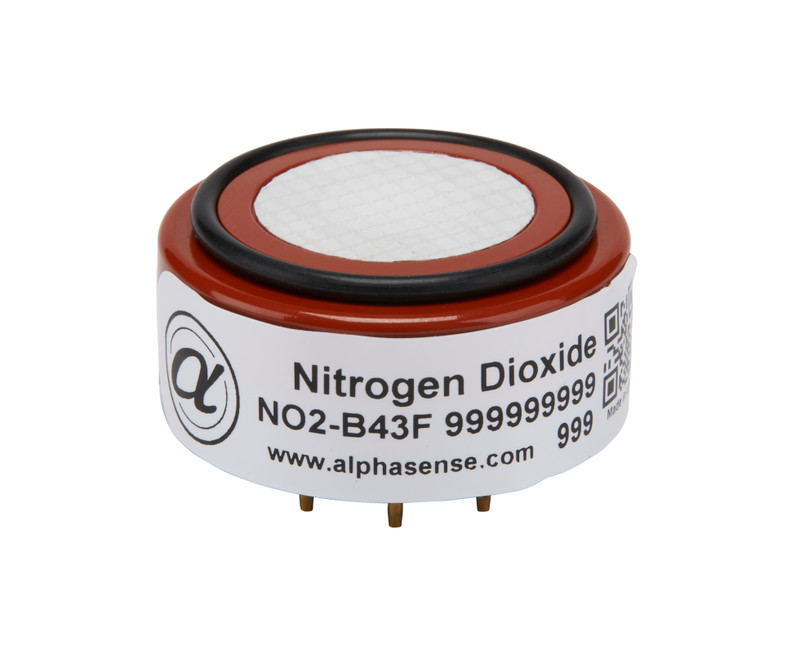
NO2-B43F
- Technology
- Four-electrode electrochemical NO₂ cell
- Measurement
- 20 ppm stated range limit; −200 to −650 nA/ppm at 2 ppm NO₂
- Interface
- Signed electrode current; analog front end required
- Consider for
- Environmental NO₂ instrument development
- Integration consideration
- Ozone filter and auxiliary electrode require model-specific treatment. Noise is specified with Alphasense ISB circuitry.
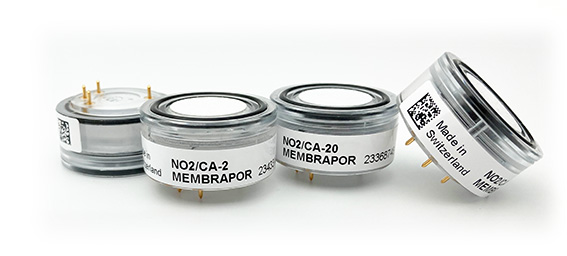
NO2/CA-2
- Technology
- Three-electrode electrochemical NO₂ cell with ozone filter
- Measurement
- Nominal range 0–2 ppm; −650 ±150 nA/ppm
- Interface
- Electrode current; potentiostat and readout circuitry
- Consider for
- Continuous NO₂ monitoring instrument designs
- Integration consideration
- December 2025 sheet: performance data at 20–25 °C, 30–50% RH and 900–1,100 mbar. Filter life has a stated ozone exposure condition.
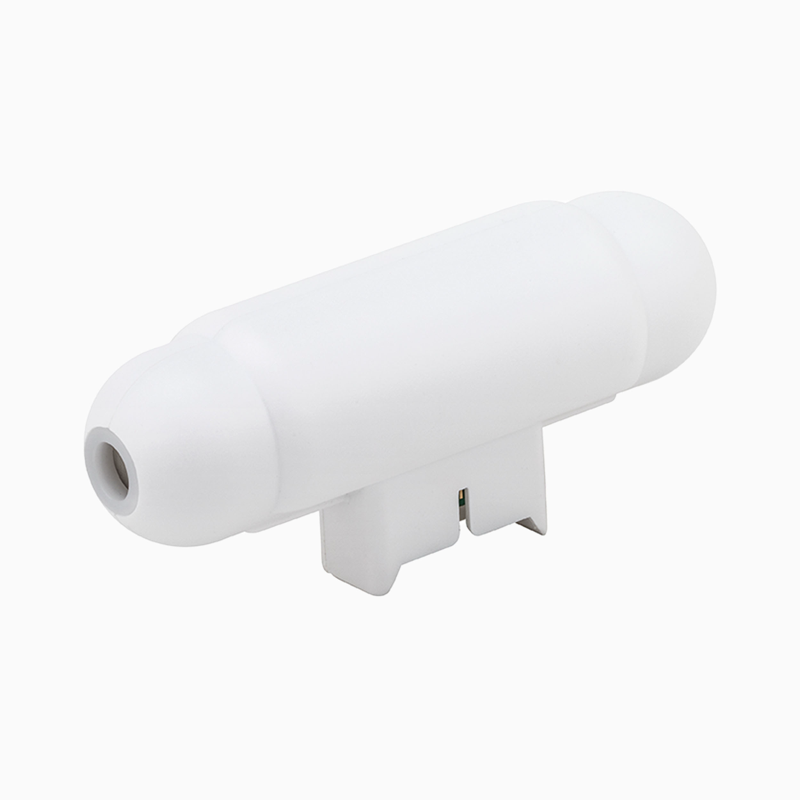
END / END2 NO₂ head
- Technology
- Sampled electrochemical sensor head with ozone filter
- Measurement
- 0–1 ppm; minimum detection limit 0.005 ppm
- Interface
- Compatible Aeroqual monitor host required
- Consider for
- Portable measurements with supported Aeroqual monitors
- Integration consideration
- Head-specific factory-calibration accuracy: <±0.02 ppm at 0–0.2 ppm; <±10% at 0.2–1 ppm. Fixed analyzer-module figures apply separately.
Alphasense values refer to the standard NO2-B43F cell and Version 1.1 documentation. NO2-B43F+ adds memory and temperature functions. Membrapor values refer to the December 2025 NO2/CA-2 sheet. Aeroqual values refer to the filtered 0–1 ppm END-family head; its fixed analyzer module has a separate specification.
Aeroqual lists a 0.001 ppm display resolution and a 0.005 ppm minimum detection limit for this head, corresponding to 1 ppb and 5 ppb. Its stated factory-calibration accuracy in the 0–0.2 ppm region is less than ±0.02 ppm. Evaluating these figures together helps determine whether the instrument meets a particular low-level monitoring objective.
Sampling, calibration and interface design.
For a bare cell, specify the electrode circuit, input-current range, baseline adjustment and manufacturer-recommended operating potential. Use the exact model’s application notes. The auxiliary electrode and the electronics’ temperature response need appropriate characterization before applying a correction to field data.
Choose sampling materials and inlet geometry suitable for reactive gases. Tubing length, residence time, surface interactions, contamination and condensation can alter the sample reaching the sensor. Document inlet height, nearby emission sources, shielding and airflow. Record temperature and humidity with the gas readings to support interpretation and instrument checks.
Calibrate with the target gas and the prescribed zero, span, flow and stabilization procedure. Check interference-filter condition and service intervals. Membrapor specifies its filter-life statement at a particular ozone exposure condition; a different exposure history needs assessment. A model’s general service life should be considered alongside filter performance and calibration results.
Collocate a completed instrument with a suitable reference across representative conditions. Evaluate bias, drift, response lag and errors at the concentrations of interest. Correlation alone provides incomplete information about agreement. Retain raw signals, correction coefficients, timestamps, averaging rules, sensor identifiers and calibration dates so processed results can be traced to the measurements.
For gateway integration, a bare cell needs an analog front end and a host that produces a documented output. A complete transmitter may offer a voltage, current-loop or RS485 interface. Aeroqual sensor heads use their specified host connection; direct RS485 or gateway compatibility should be confirmed from the complete instrument documentation. Verify power, protocol, scaling and fault reporting before wiring.
Nitrogen dioxide sensor questions.
Why can ozone affect an NO₂ reading?
The electrochemical channel can respond to both oxidizing gases. A model-specific selective filter or compensation method reduces that response. Performance depends on the complete instrument and its operating conditions.
What does negative nA/ppm sensitivity mean?
It indicates the direction of current change under the manufacturer’s convention. Concentration is calculated using the signed sensitivity and the measured baseline.
How should an older Aeroqual evaluation be used?
Check the sensor code, publication date and test conditions. The filtered END design replaced earlier ENW models in 2020, so results for earlier units require that qualification.
Can these sensors provide an NOₓ measurement?
The listed channels measure NO₂. A nitrogen-oxide analyzer or a suitable combination of NO and NO₂ measurements is needed for an NOₓ result.
Read the original documentation.
Specifications use the linked manufacturer documents and their stated revisions. Review the current datasheet and exact ordered variant before final specification. Comparisons use manufacturer specifications and technical documentation.
- Basic Information about NO2 | US EPA
- Nitrogen Dioxide sensor NO2-B43F - Alphasense - B2B
- Alphasense NO2-B43F / NO2-B43F+ specifications
- Membrapor NO2/CA-2 specification sheet
- NO2/CA-2: Erhöhte Empfindlichkeit - Membrapor
- Nitrogen Dioxide Sensor 0-1ppm - Aeroqual
- Nitrogen Dioxide Analyzer Module, NO2 Sensor & Air Monitors | Aeroqual
- New Nitrogen Dioxide Sensor For Interference Free Measurements
- Assessing the accuracy of commercially available gas sensors for the measurement of ambient ozone and nitrogen dioxide - PMC