Particle size, number and mass concentration.
Particulate matter consists of suspended solid particles and liquid droplets. PM2.5 and PM10 describe size-selective mass fractions associated with aerodynamic diameters of 2.5 and 10 micrometres. Concentration is commonly reported in micrograms per cubic metre, μg/m³. Particle number concentration counts particles in a volume; it is not the same quantity as mass concentration.
Cooking, combustion, outdoor infiltration and dust disturbances can all change particle readings. A time series can help locate an event, compare rooms or evaluate a filtration intervention. It cannot identify the chemical composition of every particle. Keep the sampling location, humidity and activity records with the data.
Laser scattering and mass estimation.
An optical sensor moves air through a sensing volume. Particles crossing a light beam scatter some of that light toward a detector. Signal magnitude and processing help estimate particle size or concentration. Some devices classify individual particle pulses; others emphasize aggregate mass estimates. In both cases, flow control and optical cleanliness matter.
To calculate mass from optical information, an instrument needs assumptions about particle size, shape, density and optical properties. A calibration aerosol does not represent every mixture of soot, salt, dust and droplets. Optical diameter also differs from aerodynamic diameter. Treat PM outputs as estimates under a defined sensor model, and examine performance for the aerosol and environment you intend to monitor.
Humidity can make hygroscopic particles grow and scatter more light. Fog droplets can also contribute to the signal. A single generic correction is not guaranteed to work across sites. Compare the sensor alongside a suitable reference over representative conditions before using it to support consequential decisions.
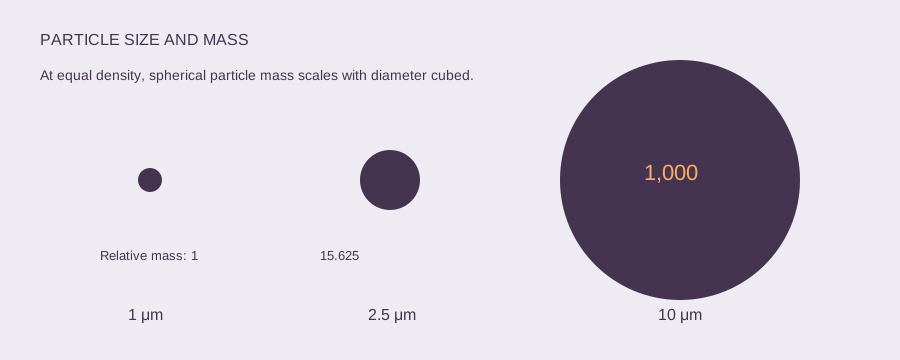
Particulate matter measurement terms.
- μg/m³
- Micrograms of particulate material per cubic metre of air. Retain the unit with every stored value.
- Size bin
- A range of particle sizes used to group estimated particle counts. Bin boundaries and detection efficiency differ between instruments.
- Detection efficiency
- The fraction of particles of a given size that the instrument detects. A listed size channel does not guarantee equal sensitivity to every particle in that channel.
- Collocation
- Operating a sensor near a reference instrument to compare observations under the same ambient conditions.
- Averaging interval
- The time represented by a reported value. A short event peak and an hourly or daily average describe different things.
From collected mass to continuous signals.
Filter-based gravimetric methods collect particles and determine mass by weighing. Continuous instruments provide a different route to time-resolved information. Compact lasers, detectors and fans enabled smaller optical sensors that can be placed in many locations, although size and convenience do not remove the need for evaluation.
The US EPA published its original Air Sensor Guidebook in 2014 and an enhanced edition in 2022. That evolution reflects a growing emphasis on defining the monitoring question, understanding sensor performance and evaluating data. A network is useful when the measurements and their limitations are documented.
Particulate matter sensor manufacturers.
The SPS30 is an integration-oriented PM module. The OPC-N3 is an optical particle counter for projects that need particle distribution information as well as PM outputs. Compare host electronics, sampling geometry and maintenance along with the sensing element.
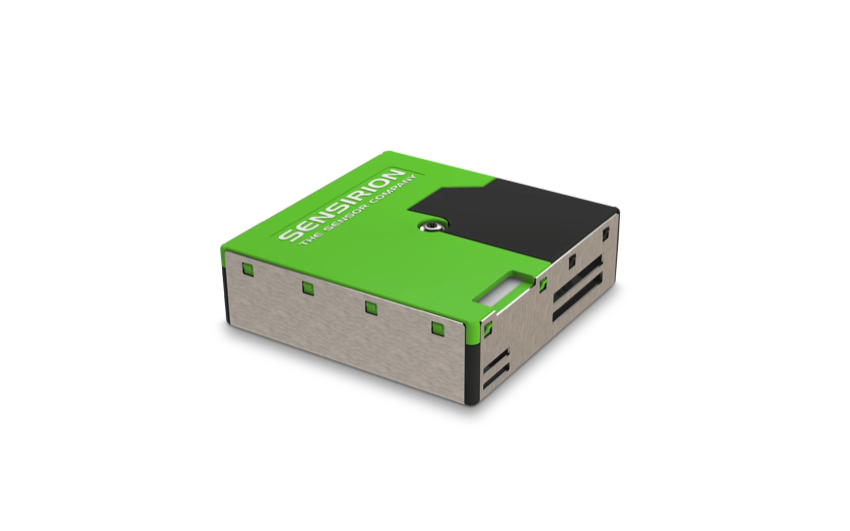
SPS30
- Technology
- Laser-scattering PM module
- Measurement
- PM1, PM2.5, PM4 and PM10 outputs
- Interface
- I²C / UART
- Consider for
- Embedded air-quality monitoring
- Integration consideration
- Mass is inferred from scattering. Preserve inlet and outlet geometry.
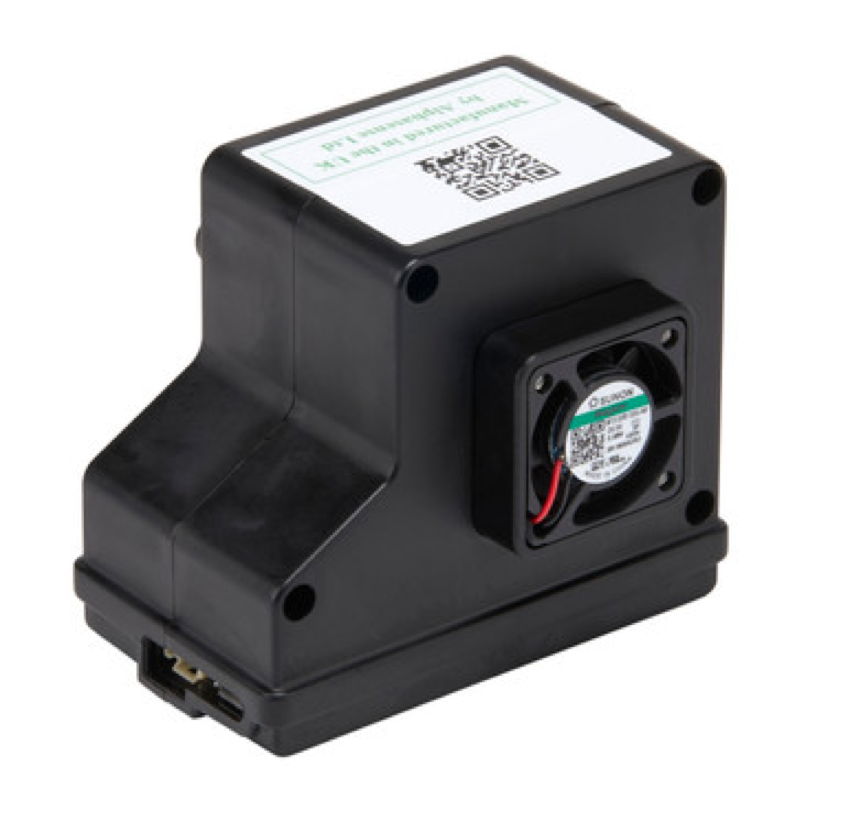
OPC-N3
- Technology
- Optical particle counter
- Measurement
- PM1, PM2.5, PM10 and PM4.25 outputs
- Interface
- SPI; see manufacturer cable and datasheet
- Consider for
- Particle-size distribution projects
- Integration consideration
- Needs host electronics and a protected sampling design.
A manufacturer certification or performance result applies to its stated instrument, method and test conditions. It does not make every enclosure built around that component a regulatory reference monitor.
Sampling inlets and maintenance.
Give the inlet and outlet the clearances prescribed by the manufacturer. Avoid recirculating exhaust into the inlet. Outdoors, prevent rain and insects entering the sampling path while preserving representative airflow. Long tubes, sharp bends and filters can remove particles before they reach the sensor, changing the measurement.
Maintain fans and optics as instructed. Log cleaning dates, fan faults, restarts and firmware changes. If a sensor is power-cycled to save energy, check stabilization time before accepting readings. Compare sensors side by side before distributing them across a site, and repeat comparisons when drift or contamination is suspected.
Store the raw reported PM channels, humidity and timestamps before applying correction. Mark corrected data separately and preserve the correction method. Compare equivalent averaging intervals; an instant reading should not be presented as a daily average or converted casually into an air-quality index with different averaging rules.
Particulate matter sensor questions.
Does PM2.5 identify smoke?
It identifies a particle-size mass fraction, not a unique source. Smoke, droplets and other fine aerosols can contribute. Source interpretation needs context or additional measurements.
Why do two sensors disagree?
Differences can come from aerosol calibration, inlet position, airflow, humidity, contamination or averaging. Collocate them and review those factors before assuming one is correct.
Can a PM sensor detect VOC gases?
No. A particle sensor detects suspended material. Use an appropriate gas sensor for VOC measurements.
Read the original documentation.
Specifications use the linked manufacturer documents and their stated revisions. Review the current datasheet and exact ordered variant before final specification. Comparisons use manufacturer specifications and technical documentation.