Oxygen volume fraction and partial pressure.
Oxygen sensors support inerting, controlled atmospheres, gas analysis and monitoring of spaces where oxygen composition may change. The required range may cover small deviations around air composition, an oxygen-depleted process or an oxygen-rich mixture. Pressure, humidity and sample delivery belong in the specification.
Volume fraction is commonly reported as percent O₂. Oxygen partial pressure expresses oxygen's contribution to total pressure, usually in mbar or another pressure unit. An optical sensor that measures partial pressure needs the corresponding total pressure to calculate oxygen fraction.
For a gas mixture with a hypothetical oxygen fraction of 20.9%, partial pressure is 211.7 mbar at a total pressure of 1,013 mbar. At 800 mbar total pressure, the same fraction gives 167.2 mbar oxygen partial pressure. These examples assume consistent gas-composition and pressure definitions.
Oxygen measurements used for personnel protection require suitable instruments, checks and site procedures. A sensor's numerical output alone cannot establish that a sampled space is safe to enter.
Galvanic reactions and optical luminescence quenching.
A galvanic oxygen cell produces an electrical signal through reactions at its electrodes. Oxygen transport into the cell and the electrochemical design determine its output. Some designs provide current; others provide a millivolt signal through their specified internal arrangement.
Alphasense O2-A2 specifies current at 20.9% O₂. Maxell KE-25, distributed by Figaro, specifies an initial voltage at 21% O₂. The instrument must use the correct loading, readout and calibration procedure for the actual cell. Diffusion design influences pressure behavior, so compensation cannot be assigned from the word “galvanic” alone.
Optical oxygen sensors use luminescence quenching. Oxygen changes the behavior of an excited sensing material, and electronics relate that change to partial pressure. SST's LuminOx combines this measurement with ambient-pressure measurement to report an oxygen fraction.
The fraction is calculated as oxygen partial pressure divided by total pressure, multiplied by 100. Uncertainty in both measurements contributes to the result. LuminOx's display resolution therefore cannot be used as a substitute for concentration accuracy.
Galvanic cells have consumable electrochemical materials and specified lifetime conditions. Optical sensing avoids that particular consumption mechanism, while the complete optical module still requires environmental suitability, calibration assessment and maintenance of its sample access.
Oxygen measurement terminology.
- Oxygen fraction
- Oxygen's proportion of the gas mixture, commonly expressed as percent.
- Partial pressure
- The pressure contribution associated with oxygen in the mixture.
- Barometric pressure
- Total ambient pressure used by a module when deriving oxygen fraction.
- Galvanic cell
- An electrochemical cell producing an electrical signal through its electrode reactions.
- Luminescence quenching
- Change in an excited material's optical response caused by oxygen.
- Full-scale accuracy
- An error specification referenced to the stated measurement span, rather than to each reading.
- Dry or wet basis
- Gas-composition reporting that excludes or includes water vapor, respectively.
- Sampling geometry
- The physical arrangement through which gas reaches the sensing element.
Galvanic components and digital optical modules.
Figaro's published KE-series technical document was revised in July 2018 and describes Maxell's galvanic oxygen components, output characteristics and operating conditions. It remains the source for the KE-25 comparison here.
SST's later LuminOx documentation describes an integrated optical module with partial-pressure and barometric-pressure measurement. The archived Rev 17 sheet lists 10–45 °C operation; the currently supplied Rev 18 document lists 0–45 °C. This guide uses Rev 18 and preserves the earlier revision in the research archive. Document revisions and mechanical variants require explicit checking during specification.
Oxygen manufacturer and model options.
Alphasense O2-A2 provides an analog-current cell. Maxell KE-25, available through Figaro, provides a galvanic millivolt output with a documented 0–100% oxygen range. SST LuminOx LOX-02 provides digital optical measurement within its specified fraction and pressure ranges.
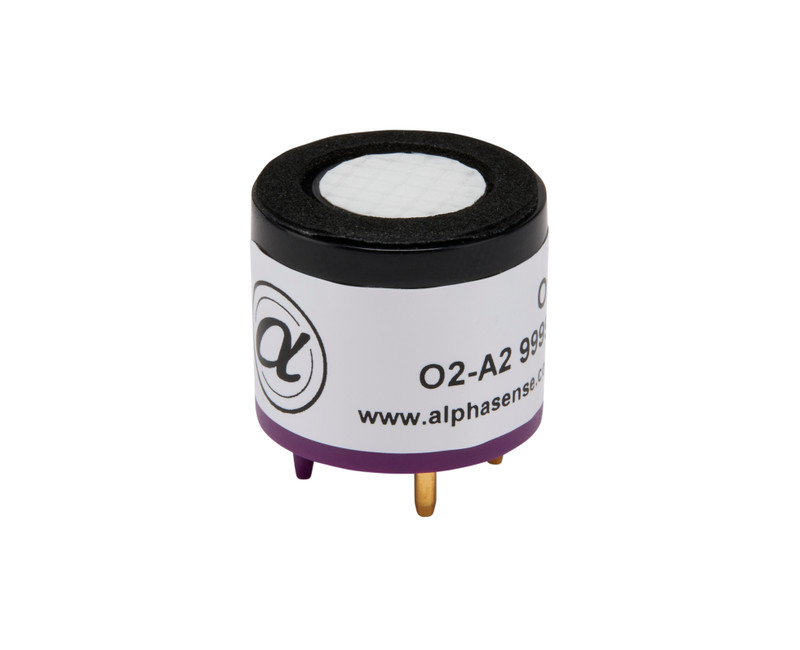
O2-A2
- Technology
- Galvanic electrochemical cell
- Measurement
- 80–120 µA at 20.9% O₂; T90 <13 s for 20.9% to zero O₂
- Interface
- Analog current; load and readout circuitry required
- Consider for
- Embedded oxygen instruments
- Integration consideration
- Operating range −30 to +55 °C. Lifetime and pressure specifications retain their stated test conditions.
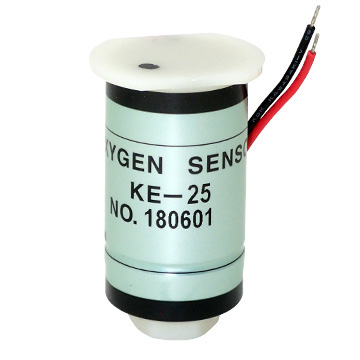
Maxell KE-25
- Technology
- Galvanic oxygen cell
- Measurement
- 0–100% O₂; initial 10–15.5 mV at 21% O₂; T90 14 ±2 s
- Interface
- Millivolt output; high-impedance measurement
- Consider for
- Oxygen concentration instrument designs
- Integration consideration
- Maxell model distributed by Figaro. Accuracy and lifetime depend on technical-document conditions; public revision July 2018.
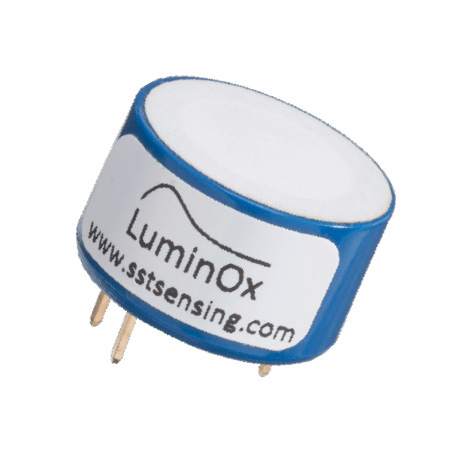
LuminOx LOX-02
- Technology
- Optical luminescence-quenching module
- Measurement
- 0–25% O₂; 0–300 mbar oxygen partial pressure
- Interface
- 3.3 V TTL UART, 5 V tolerant; nominal 5 V supply
- Consider for
- Digital oxygen and pressure measurements
- Integration consideration
- Original fully immersed LOX-02 variant. Current Rev 18 specifies 0–45 °C; sealed and flow-through versions have different sampling arrangements.
O2-A2's cited datasheet specifies output at 20.9% oxygen; confirm the required concentration range with the manufacturer. KE-25's accuracy uses a full-scale reference and document conditions. LuminOx lists partial-pressure and pressure accuracy separately, which must be considered together when assessing derived concentration.
Pressure handling, sample access and calibration.
Define the gas mixture, pressure range, humidity, temperature and reporting basis. Pressure changes can affect the sensing mechanism or derived fraction. Follow the model's documented pressure behavior and avoid applying a generic correction across different diffusion designs.
Prevent uncontrolled condensation and verify that the sample reaches the sensing element. Original LOX-02 is intended to be immersed in the sample gas. Sealed LOX-02S and flow-through variants have different mechanical arrangements; their sampling instructions should remain attached to their own model records.
Calibrate using the manufacturer's procedure and an appropriate reference gas. Treat ambient air as a reference only under the method's required conditions. Record pressure and humidity where relevant, and verify response after changes in tubing, enclosure or flow.
O2-A2 requires suitable current measurement and cell loading. KE-25 needs the prescribed high-impedance voltage measurement. LOX-02 uses nominal 5 V power and a 3.3 V TTL UART that is specified as 5 V tolerant. Industrial serial integration requires compatible electrical levels and protocol handling.
Include replacement-cell life, calibration, pressure handling, enclosure and interface hardware in ownership cost. Keep faults, calibration states and sampling interruptions in the data record. For alarm applications, choose complete equipment suitable for the installation and maintain its specified functional checks.
Oxygen sensing questions.
Why can partial pressure change while percent oxygen stays constant?
Partial pressure equals gas fraction multiplied by total pressure. A pressure change alters partial pressure even when the mixture's oxygen fraction remains the same.
Can LOX-02 be installed like the sealed LOX-02S?
The original module is intended to be surrounded by sample gas. Sealed and flow-through models use different sampling arrangements and require their own instructions.
Does a galvanic cell have unlimited service life?
Its electrochemical materials are consumed during operation. Lifetime depends on the model and documented exposure and operating conditions.
Can LOX-02 connect directly to an RS485 input?
Its documented output is TTL UART. Appropriate electrical conversion and protocol support are needed for industrial serial acquisition.
Read the original documentation.
Specifications use the linked manufacturer documents and their stated revisions. Review the current datasheet and exact ordered variant before final specification. Comparisons use manufacturer specifications and technical documentation.