Optical gas absorption with acoustic detection.
Photoacoustic gas sensing detects pressure changes produced after a gas absorbs modulated light. Compact CO₂ products use this approach to provide a digital concentration in ppm. The selected absorption band and calibration define the target gas.
Measurement range, numerical output range and accuracy range should remain separate. Sensirion SCD41 specifies accuracy within 400–5,000 ppm while permitting a wider numerical output. Infineon PASCO2V01 similarly distinguishes functional range from its specified accuracy interval.
These are direct gas-responsive optical measurements. Interpretation still needs the sensor's calibration, pressure treatment and operating conditions. The sensing principle alone does not establish performance in an arbitrary enclosure.
Modulated heating and pressure oscillations.
Absorbed light energy is transferred into the gas, producing a periodic thermal and pressure response. An acoustic detector measures that response, and electronics convert it through the sensor's calibrated model into concentration.
Infineon describes a MEMS acoustic detector in PASCO2V01. Sensirion describes its photoacoustic NDIR implementation in the SCD4x family. Packaging and internal algorithms differ, while both need suitable gas access and control of operating conditions.
Pressure compensation accounts for the dependence of response on ambient conditions. PASCO2V01 accepts a pressure reference through registers. The application should supply that value as documented and avoid applying a second conflicting correction to the resulting concentration.
Electrical peak demand can exceed average power. PASCO2V01's cited sheet describes both 12 V and 3.3 V supply rails, with source-pulse current on the 12 V rail. Select regulators and decoupling for the actual peak load and measurement mode.
Photoacoustic terminology.
- Modulation
- Controlled periodic variation of the optical excitation.
- Acoustic detector
- The element measuring pressure changes within the sensing arrangement.
- Absorption band
- The selected wavelength region associated with the target gas.
- Pressure reference
- The ambient-pressure value used for the module's compensation.
- Single-shot mode
- A supported measurement triggered individually rather than continuously.
- Automatic baseline correction
- A model-specific adjustment requiring documented reference exposure.
Miniaturization and distinct hardware generations.
Sensirion's miniaturization article contrasts SCD30 and SCD4x form factors and sensing implementations. Its April 2025 SCD4x revision separates SCD40, SCD41 and SCD43 accuracy specifications.
Infineon introduced its 5 V PAS CO₂ product on 16 September 2024. The PASCO2V01 record compared here describes the separate 12 V product in the September 2025 datasheet. Supply and performance details must retain their hardware generation.
Photoacoustic manufacturer options.
Sensirion SCD41 and Infineon PASCO2V01 offer compact CO₂ sensing with different supply and interface arrangements. Both require enclosure validation and model-specific calibration handling.
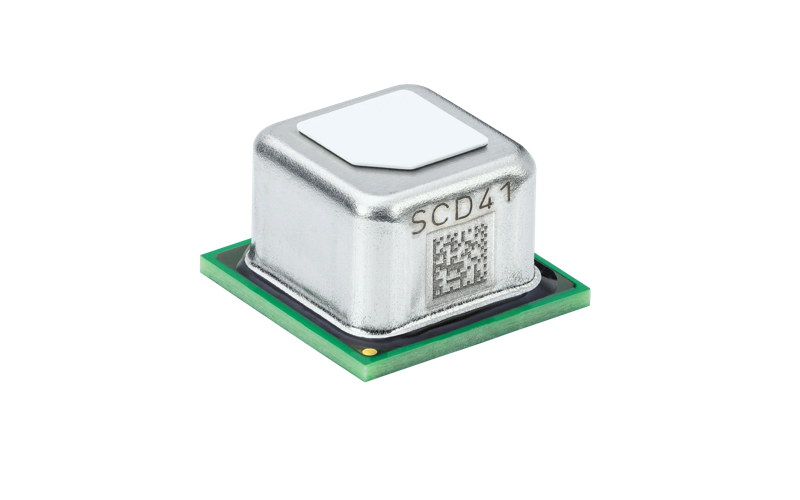
SCD41-D-R2
- Technology
- Photoacoustic NDIR CO₂ component
- Measurement
- Specified 400–5,000 ppm; wider numerical output range
- Interface
- I²C; integrated temperature/humidity compensation
- Consider for
- Compact CO₂ monitor designs
- Integration consideration
- April 2025 datasheet gives concentration-dependent accuracy. Automatic calibration requires documented reference exposure.
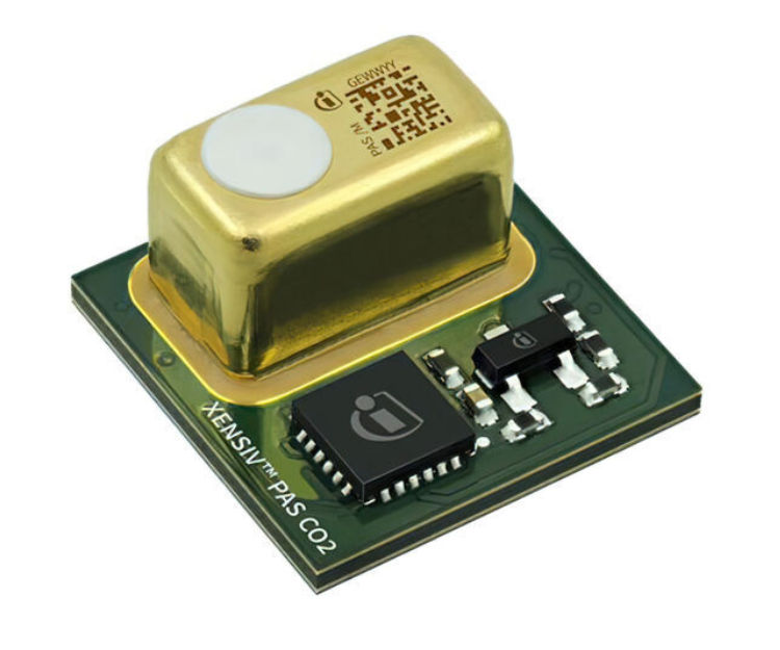
PASCO2V01
- Technology
- Photoacoustic CO₂ component
- Measurement
- Functional 0–32,000 ppm; accuracy specified within 400–5,000 ppm
- Interface
- I²C / UART / PWM; 12 V and 3.3 V supplies
- Consider for
- Embedded indoor CO₂ equipment
- Integration consideration
- This record describes the 12 V model. Pressure input, peak current and automatic baseline exposure need design attention.
SCD41's current accuracy formula changes by concentration interval. PASCO2V01's automatic baseline correction requires suitable reference exposure, specified as at least 30 minutes per operating week in the cited mode guidance. Review those conditions for continuously elevated spaces.
Mechanical, electrical and calibration design.
Maintain representative gas exchange and minimize enclosure dead volumes. Separate sensing from local heat sources and follow handling and assembly instructions. Response time is influenced by packaging and the selected measurement mode.
Assess mechanical vibration and acoustic disturbance according to the manufacturer's design-in guidance. Protect gas access without introducing an uncharacterized restriction. Verify the installed response with concentration changes under representative conditions.
Configure pressure input, temperature offset and automatic calibration as prescribed. Automatic correction is suitable only when the required reference condition occurs. Where it does not, establish a documented forced-calibration procedure.
I²C, UART and PWM support depends on the exact product. These board-level interfaces need compatible electronics for an industrial installation. Compare power, regulators, calibration effort, enclosure and replacement access as part of the complete monitoring cost.
Photoacoustic sensing questions.
How should vibration be assessed during integration?
Follow the model's mechanical guidance and test the completed enclosure under representative vibration and acoustic conditions.
Can a 12 V PASCO2V01 be wired like the 5 V product?
They are separate products. Follow the selected model's supply rails, interface levels and application circuit.
Why does automatic calibration need reference exposure?
The algorithm uses a defined reference condition to adjust baseline. A continuously elevated environment can violate that assumption.
Read the original documentation.
Specifications use the linked manufacturer documents and their stated revisions. Review the current datasheet and exact ordered variant before final specification. Comparisons use manufacturer specifications and technical documentation.