Sulfur dioxide in ambient air and industrial samples.
Sulfur dioxide, SO₂, is a reactive sulfur-containing gas associated with fuel combustion, industrial processing and volcanic emissions. Monitoring applications include ambient air networks, industrial source investigations and instrumented process systems. The sampling arrangement depends on the concentration, gas mixture and purpose of the measurement.
Ambient measurements commonly use parts per billion by volume, ppb; higher concentrations are often expressed in parts per million, ppm. One ppm equals 1,000 ppb. A 0.025 ppm reading therefore corresponds to 25 ppb. Specify the required averaging interval and measurement uncertainty alongside the expected range. The EPA sulfur dioxide overview describes the principal emission sources.
SO₂ is one constituent of a sample that may also contain other sulfur compounds. A total reduced sulfur measurement uses additional sampling and conversion equipment. A wet combustion sample can also require conditioning or dilution before it reaches an ambient analyzer. Establish the measured species, water-vapor basis and any conversion or dilution factor in the system specification.
Electrochemical cells and UV fluorescence.
Electrochemical sensing
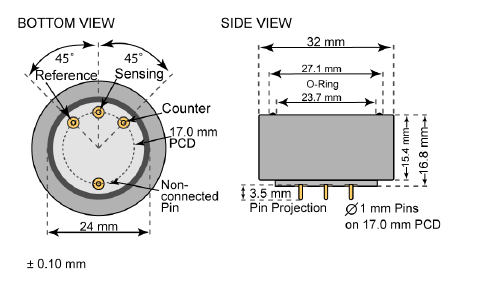
An electrochemical cell controls the diffusion of SO₂ to a working electrode. Electrode reactions produce a current that the readout converts into concentration using the measured baseline and calibrated sensitivity. A reference electrode supports potential control, while the counter electrode completes the electrochemical circuit. Four-electrode cells add an auxiliary signal that can support baseline correction.
For a linear calibrated channel, concentration is calculated from the baseline-subtracted current divided by sensitivity. Both quantities depend on the particular cell and its operating conditions. The instrument must account for input-current range, electrode polarity, temperature response and any interference correction. A cell’s nA/ppm sensitivity specifies its electrical response; completed-instrument accuracy also depends on the readout and calibration.
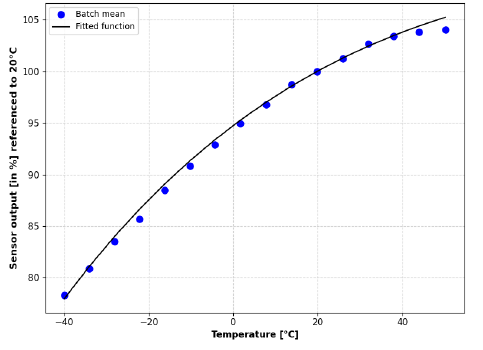
Membrapor’s SO2/C-20 sheet plots batch-mean sensitivity against temperature, normalized to the response at 20 °C. The curve describes the documented batch behavior; characterize the complete instrument before applying a temperature correction in field measurements.
Pulsed ultraviolet fluorescence
SO₂ molecules absorb ultraviolet light and enter an excited state. As they return to lower energy states, they emit light at different wavelengths. An analyzer separates this emission from the excitation light and measures it with a detector. In the calibrated operating range, the fluorescence signal supports conversion to SO₂ concentration.
Thermo Scientific’s 43iQ uses a pulsed UV source, optical filtering and a photomultiplier detector. Its sampling path includes a hydrocarbon removal stage to reduce fluorescence interference. Monitoring the excitation source helps compensate for changes in lamp output. Sample flow, optical cleanliness and interfering species remain part of the instrument’s performance.
SO₂ measurement parameters.
- Baseline and zero drift
- The output in a defined zero-gas condition and its change over time. Record the zero-gas composition, temperature and adjustment history.
- Sensitivity
- Change in output per unit concentration. Electrochemical cells commonly specify this in nA/ppm; calibrate the individual channel.
- Span drift
- Change in response to a specified nonzero concentration. A stable baseline can accompany a changed sensitivity.
- Detection limit
- A low-concentration limit established with a specified method, noise criterion and averaging interval.
- T90
- Time to reach 90% of the final signal after a defined concentration step. Tubing and sample conditioning add their own delay.
- Quenching
- Reduction of fluorescence when excited molecules lose energy through processes that do not produce the detected light.
- Cross-sensitivity
- Response to another gas, including its sign and tested concentration. Positive and negative interferences affect interpretation differently.
- Wet and dry basis
- Concentration expressed with water vapor included or removed from the gas basis. Preserve that distinction when reporting conditioned process samples.
Assume a hypothetical electrochemical channel has calibrated sensitivity of 400 nA/ppm. A 25 ppb SO₂ increase would produce a 10 nA current change. A residual baseline error of 4 nA would correspond to 10 ppb at that sensitivity. The calculation assumes linear response and fixed sensitivity; it demonstrates how baseline uncertainty affects a low-concentration result.
Development of continuous SO₂ monitoring.
Continuous sulfur dioxide instruments developed through several analytical approaches, including fluorescence, conductometric and photometric methods. An EPA report published in January 1984 compiled manufacturer and agency evaluations of designated ambient SO₂ analyzers. It included 13 predesignation test summaries, 10 postdesignation performance evaluations and eight comparative evaluations.
Those historical tests assessed drift, interference and agreement between instruments, including the earlier Thermo Electron Model 43. Their model identities and test conditions belong to that period. The current 43iQ has its own manual, configuration and performance specifications.
Compact electrochemical cells extended instrument-design options for portable and distributed measurements. EPA’s later air-sensor testing framework includes SO₂ in the February 2024 gas-sensor supplement for outdoor, fixed-location, non-regulatory supplemental and informational monitoring. That scope supports evaluating a complete sensor system in its intended environment.
Alphasense, Membrapor and Thermo Scientific.
Alphasense SO2-B4 and Membrapor SO2/C-20 are cells requiring electrode electronics and an instrument host. Thermo Scientific 43iQ is a complete sampled fluorescence analyzer. Compare the assembled measurement system, including power, sampling, calibration access and the ordered communications package.
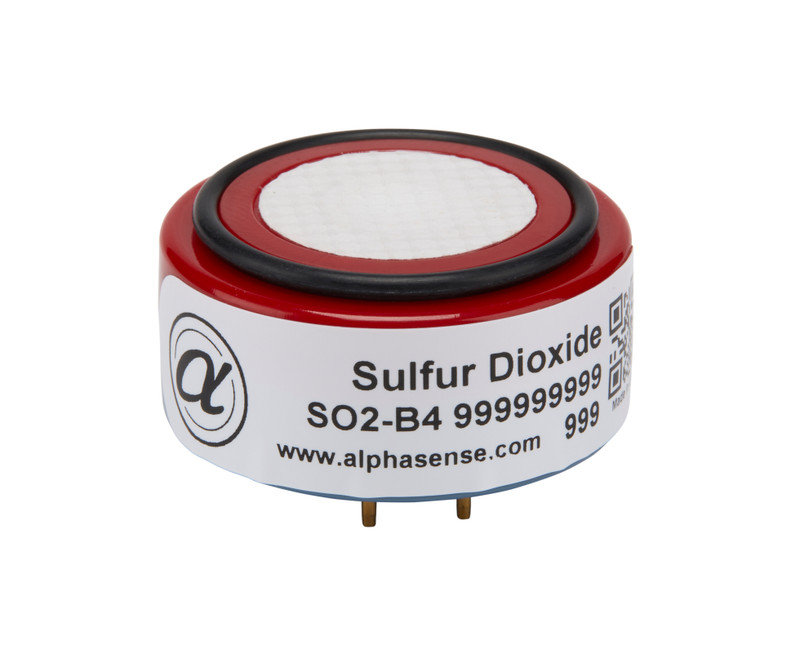
SO2-B4
- Technology
- Four-electrode electrochemical SO₂ cell
- Measurement
- 100 ppm stated range limit; 275–520 nA/ppm at 2 ppm SO₂
- Interface
- Electrode current; analog front end and calibrated host required
- Consider for
- Low-concentration environmental instrument designs
- Integration consideration
- T90 <60 s for zero-to-2 ppm step. Noise specification depends on ISB circuitry. Standard cell and SO2-B4+ memory/temperature variant need distinct integration.
SO2/C-20
- Technology
- Three-electrode electrochemical SO₂ cell
- Measurement
- Nominal 0–20 ppm; output 1,000 ±300 nA/ppm
- Interface
- Electrode current; potentiostat and readout circuitry
- Consider for
- SO₂ instrument development within documented sample conditions
- Integration consideration
- T90 <15 s; no inboard filter. Performance data at 20–25 °C, 30–50% RH and 900–1,100 mbar. Check the specified cross-sensitivity tests.
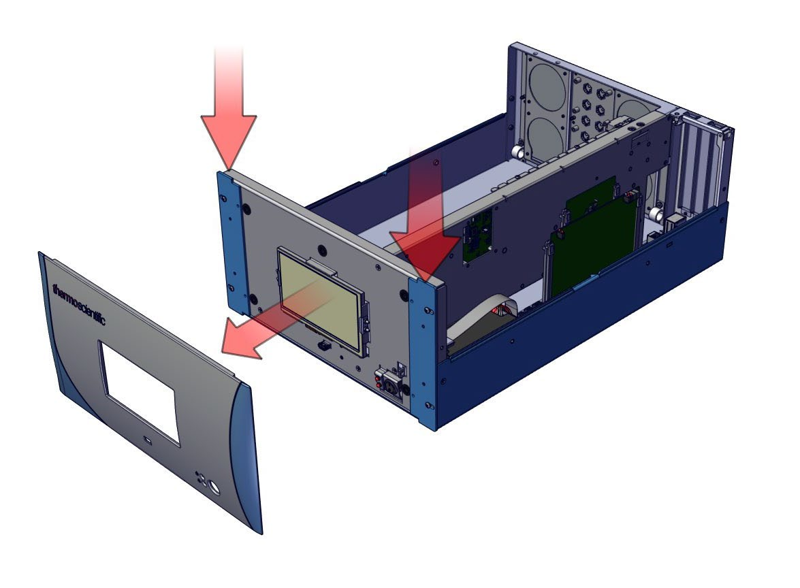
43iQ
- Technology
- Pulsed UV fluorescence SO₂ analyzer
- Measurement
- 0–10 ppm; extended range 0–100 ppm; 1 ppb detection limit at 60-second averaging
- Interface
- Ethernet; optional serial RS232/RS485 and analog/digital I/O
- Consider for
- Complete sampled ambient analyzer installations
- Integration consideration
- Verify ordered I/O hardware. Standard flow 0.5 L/min; specified supply 100–240 VAC, 275 W. Includes optical and sampling service requirements.
Alphasense values use Version 1.1 SO2-B4/SO2-B4+ technical specifications; the comparison covers the standard cell. Membrapor values use the December 2025 SO2/C-20 sheet. Thermo Scientific values use the 43iQ instruction manual dated 5 February 2024. The 43i and 43iQ have separate documentation.
The SO2-B4 sheet specifies 5 ppb-equivalent noise using an Alphasense ISB low-noise circuit and a ±2-standard-deviation criterion. Membrapor specifies electronics-dependent resolution below 0.05 ppm, equivalent to 50 ppb. These describe different properties of a channel. Establish completed-instrument uncertainty at the concentrations of interest before selecting either cell for a low-level application.
The 43iQ lists a 1 ppb detection limit at 60-second averaging and a 110-second response time with that averaging setting. Increasing averaging to 300 seconds changes the stated detection limit to 0.25 ppb and response time to 320 seconds. Select a setting that meets both the concentration and timing requirements.
Sample integrity, interference and calibration.
SO₂ sampling requires attention to surface interactions, moisture and condensation. Specify the inlet, tubing, filter and conditioning system using the exact instrument’s requirements. For the 43iQ, the manual describes suitable inlet materials and delivery at atmospheric pressure, together with an unrestricted exhaust route. A hot or wet process stream needs a sampling design appropriate to that sample and the analyzer.
Check the complete gas mixture for interference. Membrapor’s SO2/C-20 sheet lists approximately 17 ppm response to a 20 ppm H₂S test and a negative response to its NO₂ test. Those figures are specific test results. They identify a need to evaluate interfering gases at representative concentrations and to retain the sign of the response. The NO₂ guide discusses baseline and interference treatment in another electrochemical channel.
Calibrate using suitable zero gas and documented SO₂ standards. Record cylinder or reference identification, concentration uncertainty, flow, tubing, stabilization and environmental conditions. Check both zero and span. Filters and sample conditioning can change delivery of the target gas, so include the installed sample path in verification where the procedure allows.
For outdoor monitoring, record temperature and humidity and collocate the completed instrument with a suitable reference across representative conditions. Assess bias, drift, sample delay and errors in the relevant range. Preserve raw electrode channels, calibration coefficients, averaging settings, units, timestamps and fault indicators so processed concentrations can be traced to their inputs.
For data acquisition, bare cells need electrode circuitry and a host that produces a documented output. The 43iQ manual describes Ethernet and optional serial, analog and digital I/O hardware. Confirm the installed communications board, protocol settings and register or output scaling. Plan separate instrument power and include sampling consumables, calibration gases, service and replacement parts in the ownership cost.
Sulfur dioxide sensor questions.
Can hydrogen sulfide affect an SO₂ cell?
Yes. Cross-sensitivity depends on the cell design and any filter. The SO2/C-20 sheet reports a substantial response in its H₂S test. Evaluate the specified cell in the expected gas mixture.
What changes when averaging is increased?
Averaging can reduce noise while lengthening the reported response. The 43iQ specifications pair each detection limit with an averaging setting and provide the corresponding response time.
Can a cell with a 100 ppm range support ppb measurements?
The range alone does not establish low-level performance. Noise, baseline stability, environmental correction and readout electronics determine the useful low-concentration measurement capability.
Does an SO₂ analyzer measure total reduced sulfur?
A total reduced sulfur system needs the appropriate sample treatment and conversion stages. The SO₂ analyzer is one part of that configured measurement chain.
Read the original documentation.
Specifications use the linked manufacturer documents and their stated revisions. Review the current datasheet and exact ordered variant before final specification. Comparisons use manufacturer specifications and technical documentation.
- EPA: Sulfur Dioxide Basics
- EPA: Performance Test Results and Comparative Data for Designated SO₂ Methods, January 1984
- EPA: Air Sensor Performance Targets and Testing Protocols
- Sulphur Dioxide sensor SO2-B4 - Alphasense - B2B
- Alphasense SO2-B4 / SO2-B4+ technical specifications, Version 1.1
- Membrapor SO2/C-20 specification sheet, December 2025
- Thermo Scientific 43iQ instruction manual, 5 February 2024
- Thermo Scientific: CEMS for Total Reduced Sulfur, including 43iQ