Carbon monoxide concentration.
Carbon monoxide, CO, is a colorless, odorless gas associated with combustion. Sources include engines, fuel-burning appliances and industrial processes. Measurement requirements vary substantially: an outdoor monitoring network may need to resolve changes below one part per million, while a portable detector needs to respond over its specified safety-monitoring range.
Gas concentration is usually expressed in parts per million by volume, ppm. One ppm corresponds to one part of CO in a million parts of the gas mixture. The result belongs with its timestamp, averaging interval, calibration status and measurement uncertainty. A displayed concentration alone provides little information about the instrument’s response time or condition.
CO monitoring requires a sensor specified for carbon monoxide. The infrared devices described in the CO₂ guide measure carbon dioxide, a separate gas. Multi-sensor installations can record both quantities, together with temperature and humidity, when the application calls for them.
Electrochemical sensing.
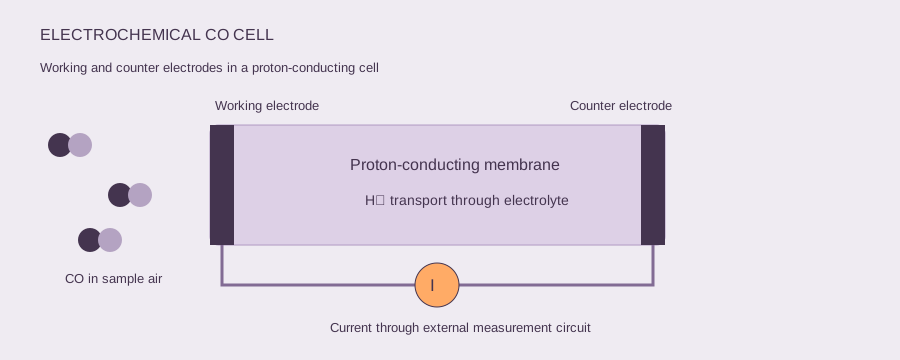
An electrochemical CO cell admits gas through a diffusion-controlled opening. At a catalytic working electrode, CO participates in an oxidation reaction. A complementary reaction occurs at the counter electrode. Ionic transport through the electrolyte and electron flow through the external circuit produce the measurement signal. Under the specified operating conditions, diffusion-limited current is approximately proportional to CO concentration.
A common reaction description for a proton-conducting CO cell is CO + H₂O → CO₂ + 2H⁺ + 2e⁻ at the working electrode. Oxygen reduction at the counter electrode completes the process. Electrode materials, electrolyte, gas admission and filters determine how a particular cell behaves.
Two-electrode cells, such as the Figaro device compared below, use working and counter electrodes. Three-electrode designs add a reference electrode so a potentiostat can control the working-electrode potential. Four-electrode designs add an auxiliary electrode that can support baseline correction. Its correction method must follow the manufacturer’s model and environmental characterization.
The small current needs suitable analog electronics. A transimpedance amplifier converts it to voltage, and an analog-to-digital converter supplies values to the host. Input leakage, offset, circuit noise and temperature drift affect the achievable measurement performance. Heated metal-oxide sensors are another CO sensing option; their heater operation and broader gas responses require a different circuit and calibration approach.
Sensitivity, baseline and response time.
- nA/ppm
- Current sensitivity: nanoamperes of signal change per ppm of CO. The host uses the calibrated sensitivity of the individual cell.
- Zero current
- The cell’s output in a specified zero-gas environment. Its value can change with temperature and age.
- Span calibration
- Adjustment or verification using a known concentration of the target gas, with the prescribed flow, exposure time and environmental conditions.
- T90
- Time to reach 90% of the final response after a defined concentration step. Compare the gas step and test conditions alongside the time.
- Cross-sensitivity
- A response to another gas, expressed relative to CO or as an apparent CO concentration under specified tests.
- Bump test
- A functional check using target gas to confirm response and alarm operation. The instrument’s instructions specify the procedure and frequency.
- Operating life
- A manufacturer’s service-life statement under stated conditions. Warranty duration, storage period and installed replacement interval are separate specifications.
As an electrical example, a cell calibrated at 70 nA/ppm would produce a 7 μA signal change at 100 ppm. An ideal current-to-voltage stage with a 100 kΩ feedback resistor would convert that change to 0.7 V in magnitude. Actual design must account for circuit polarity, baseline, input offset, supply limits and the manufacturer’s recommended circuitry.
Development of compact CO cells.
Electrochemical gas detection developed into several electrode and electrolyte configurations for portable and fixed instruments. For battery-powered equipment, a room-temperature cell can provide a signal without a heated sensing layer. Electronics, packaging and environmental characterization remain part of the complete instrument design.
A documented example of miniaturization is Figaro’s TGS5141 announcement on 10 April 2015. Figaro described an electrolyte design that removed the water reservoir used in its earlier TGS5042. The current TGS5141-P00 product information specifies the contemporary package and circuit. Historical dimensions in a launch announcement should be checked against the current model drawing before designing a carrier board.
Alphasense’s current CO-B4 documentation includes a CO-B4+ version with a separate integrated board for identification, calibration memory and temperature data. Those digital functions supplement the electrochemical cell and its analog measurement circuitry.
Alphasense, Figaro and Honeywell CO sensors.
These three components serve different integration requirements. CO-B4 is designed for low-level environmental monitoring with suitable low-noise electronics. TGS5141-P00 is a compact two-electrode option for embedded detector designs. Honeywell’s 4CM is a three-electrode cell documented for portable detection applications.
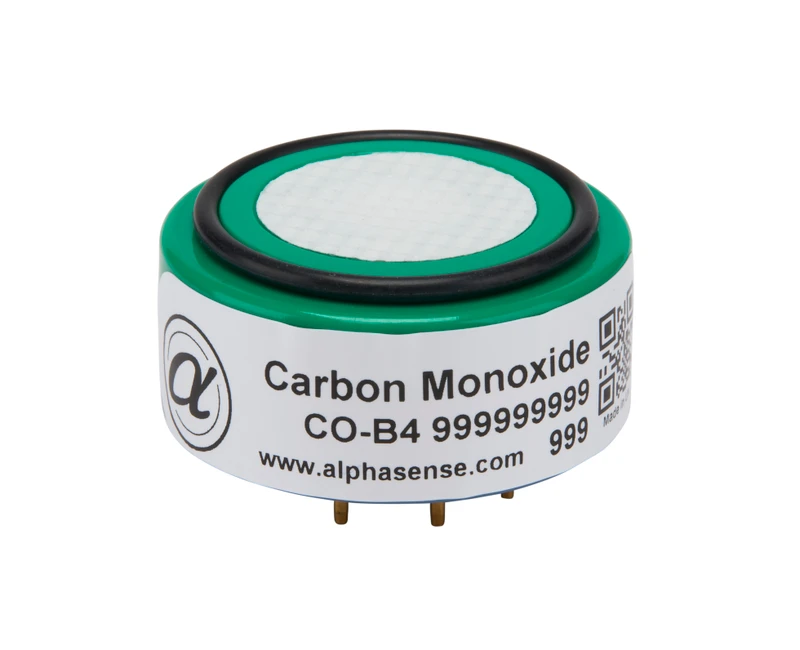
CO-B4
- Technology
- Four-electrode electrochemical CO cell
- Measurement
- 1,000 ppm range limit; sensitivity 420–650 nA/ppm at 2 ppm CO
- Interface
- Analog electrode current; low-noise front end required
- Consider for
- Low-level environmental CO monitoring
- Integration consideration
- Specified noise is measured with Alphasense ISB circuitry. CO-B4+ adds a separate data/temperature board.
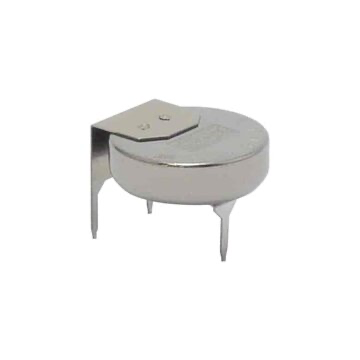
TGS5141-P00
- Technology
- Two-electrode electrochemical CO cell
- Measurement
- Typical detection range 0–5,000 ppm; 1.2–3.2 nA/ppm
- Interface
- Current output; op-amp circuit and power-off protection
- Consider for
- Compact embedded CO detector designs
- Integration consideration
- Continuous operating range −10 to +50 °C; specified humidity 10–95% RH, non-condensing.
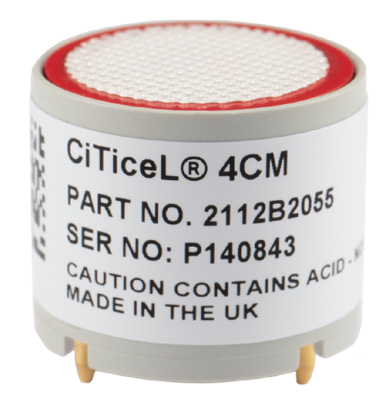
4CM
- Technology
- Three-electrode electrochemical CO cell
- Measurement
- 0–2,000 ppm; 70 ±15 nA/ppm under specified test conditions
- Interface
- Analog electrode current; potentiostat/readout circuitry
- Consider for
- Portable CO detector designs
- Integration consideration
- July 2023 datasheet gives 24-month expected life in air. Verify current ordered specification and use mating connections.
CO-B4 specifications above apply to the standard cell; the CO-B4+ board adds memory and temperature functions. Figaro values come from the April 2026 product-information revision. Honeywell values come from the July 2023 datasheet. Each model needs its own analog front end and application-specific verification.
Headline detection range is one selection criterion. Compare baseline stability, minimum useful concentration, temperature response, interference and service interval for the intended installation. A high-sensitivity environmental cell and a cell intended for portable alarms can have substantially different circuit and maintenance requirements.
Signal conditioning, calibration and maintenance.
Use the manufacturer’s electrode connections, operating potential and power-off protection. The TGS5141-P00 datasheet limits voltage applied to its sensor terminals to less than ±10 mV and describes protection against polarization when circuit power is off. Honeywell specifies mating connections for 4CM and warns that soldering directly to the sensor can damage it. These requirements belong in the carrier-board and assembly design.
Keep the gas admission path open and protect it from liquid water, dust and contaminating materials. Enclosure membranes, tubing and filters can change response time or gas transmission. Specify sampling position from the monitoring objective, expected source and applicable instrument instructions. Record exposure to solvents or high gas concentrations when reviewing sensor condition.
Zero and span checks should use the prescribed gases and procedure. Follow the instrument’s bump-test and replacement schedule. Honeywell’s July 2023 4CM datasheet gives an expected operating life of 24 months in air; it also notes that output can drift below the lower limit. Preserve signed raw signals and fault states during processing so negative drift remains visible for diagnosis.
Review cross-sensitivity for the expected gas mixture. Honeywell reports a hydrogen response in its guidance table, while Alphasense also characterizes hydrogen interference. Those test values depend on the stated concentrations and conditions. An activated-carbon filter’s protection against selected gases should be checked for its capacity and exposure history.
For remote logging, a complete CO transmitter with a documented voltage, current-loop or RS485 output can simplify the interface. Bare cells require signal conditioning and calibration before connection to a gateway. Confirm the transmitter’s supply, output scaling, register map, cable requirements and fault behavior. Record units, averaging periods, calibration dates, sensor serial number and replacement due date in the data platform.
Carbon monoxide sensor questions.
Can an indoor CO₂ monitor detect carbon monoxide?
A CO₂ monitor measures carbon dioxide. Carbon monoxide requires its own sensing channel and an instrument appropriate to the application.
Does the sensitivity value describe accuracy?
Sensitivity describes signal change per unit concentration. Accuracy also depends on calibration, baseline, environmental compensation, interfering gases and the measurement electronics.
Can a bare CO cell connect to an RS485 gateway?
A bare cell outputs a small current. It needs an analog front end and a host or transmitter that converts the calibrated measurement to an output supported by the gateway.
Does a bump test perform a full calibration?
A bump test checks instrument response and alarm function. Zero and span calibration establish or verify the measurement relationship using the manufacturer’s procedure.
Read the original documentation.
Specifications use the linked manufacturer documents and their stated revisions. Review the current datasheet and exact ordered variant before final specification. Comparisons use manufacturer specifications and technical documentation.
- Carbon Monoxide sensor CO-B4 - Alphasense - B2B
- Alphasense CO-B4 / CO-B4+ datasheet
- TGS5141-P00 : Gas Sensors & Modules - Products - Figaro Engineering Inc.
- Figaro TGS5141-P00 product information, Revision 09
- Honeywell 4CM datasheet, 002849-3-EN, July 2023
- Electrochemical type - Operating principle - Technology - FIGARO Engineering inc
- Announcement of New Ultra-Compact CO Gas Sensor TGS5141 : News - FIGARO Engineering
- Basic Information about Carbon Monoxide (CO) Outdoor Air Pollution | US EPA
- CO Alarms | US Consumer Product Safety Commission